
Orchestrating Voice and Digital Patient Access: Predictive Routing, SLOs & Governance
A practical guide to designing and operating Voice AI for patient access. Covers orchestration, identity and validation controls, predictive routing, SLO frameworks, governance boundaries, procurement trade-offs, and runbooks that keep humans in control.
1. Decision context: pick the right first use case
Voice AI succeeds in healthcare when scoped to high-frequency, low-clinical-risk tasks that reduce friction without creating new clinical or privacy exposure. This section helps leaders choose and bound that initial deployment.
Why scope matters
Healthcare organisations should prioritise administrative patient access tasks—appointment booking, routine triage for administrative routing, after‑hours messaging, and reason-for-call capture. These tasks have well-defined inputs and outputs, limited need for clinical judgment, and clear integration points with scheduling and patient‑management systems. Use cases that require diagnosis, prescribing, or emergency triage must be excluded or explicitly routed to trained clinicians.
- Select tasks with deterministic outcomes and minimal clinical decisioning.
- Define excluded behaviours: no diagnosis, no prescription, no emergency triage.
- Map each task to a transactional API or human workflow (scheduling system, intake queue, or escalation group).
Operational criteria for first deployment
Use the following checklist to validate candidate use cases before procurement and build: define success metrics, identify required integrations (EHR/PM, scheduling API, IVR/telephony), document data flows and retention points, determine human‑in‑the‑loop touchpoints, and map legal/privacy obligations. Confirm there is an existing escalation path for any ambiguous or urgent calls.
- Success metrics (examples): conversion to booked appointment, failed‑automation rate, transfer/handoff latency.
- Integration inventory: which APIs will accept bookings or updates; who owns those credentials and adapters.
- Escalation routing: live agents, clinician hotlines, or emergency services, and how Voice AI detects and flags them.
2. Operational use case: predictive routing for scheduling and intake
Predictive routing is the core operational pattern that amplifies capacity: route callers to the right resource (automated or human) based on caller intent, identity, clinical risk flags, and expected throughput.
How predictive routing works in practice
Predictive routing combines a short Voice AI-led interaction (to capture intent, appointment type, preferred time window, and basic demographics) with real‑time routing logic that scores whether booking can be completed automatically or requires a human. The routing decision matrix includes identity/validation status, schedule availability, patient priority, and risk flags (e.g., words that should escalate). When automation is allowed, the system calls the scheduling API to place a hold or book; otherwise, it routes to a specialized queue with context and a confidence score.
- Capture only necessary fields for the transaction; avoid collecting clinical details unless explicitly required for routing.
- Score routing decisions on: identity confidence, schedule match probability, urgency indicators, and agent availability.
- Attach a human‑readable context bundle for transfers: intent, fields captured, confidence score, and recommended action.
Caller -> Orchestration flow (recommended architecture)
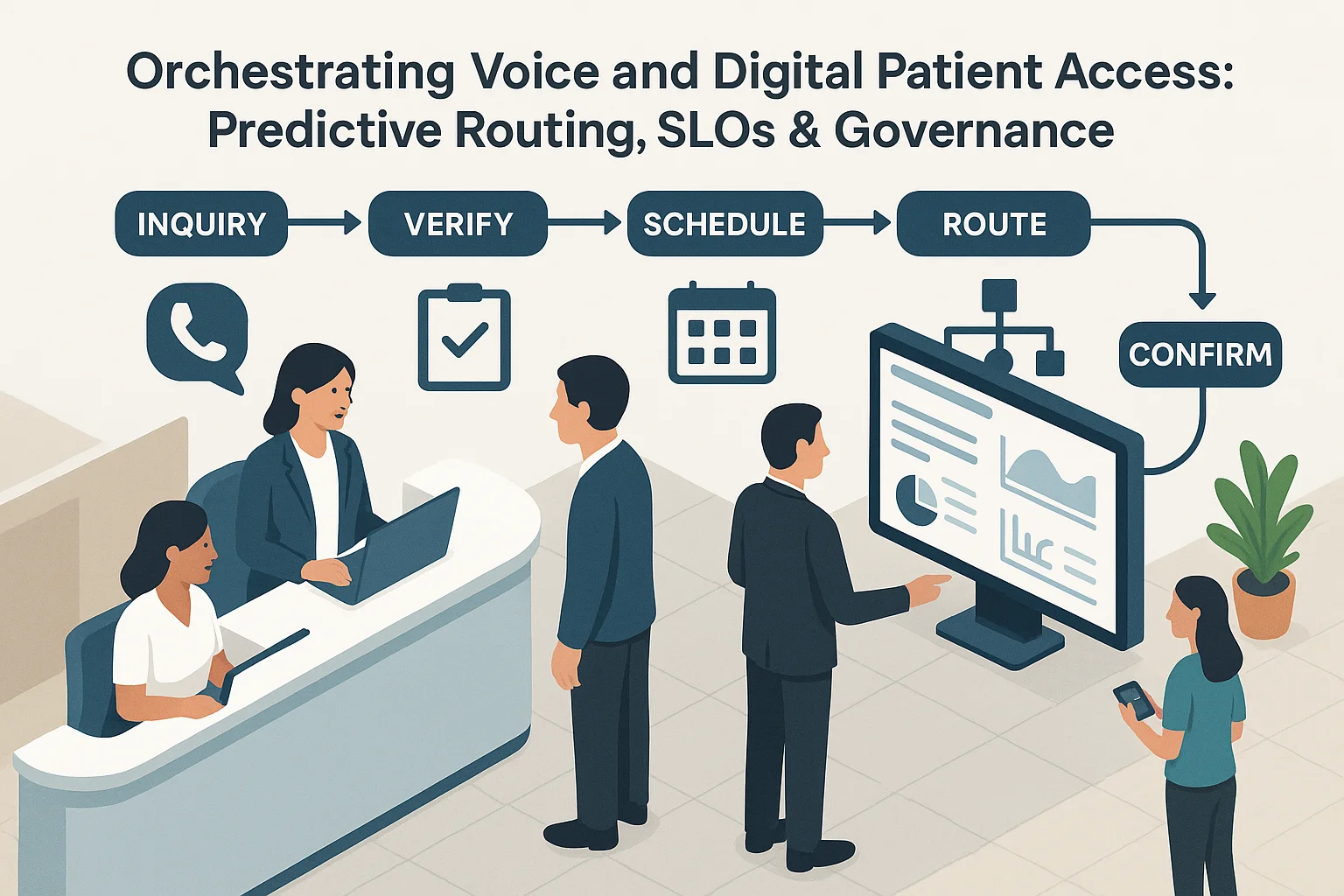
A pragmatic, auditable flow minimizes exposure while enabling automation: Patient or caller → Telephony/Voice channel → Voice AI (NLP + dialog) → validation and identity controls → orchestration service (routing logic & business rules) → approved scheduling or service API OR human handoff → confirmation & audit trail. This ensures that approval to make system changes occurs only after identity/consent checks and field validations.
- Keep orchestration logic in a controlled service that logs decisions and versions business rules.
- Enforce API-level approvals for booking actions; never allow the voice model direct write access to patient records without the orchestrator as an intermediary.
- Record structured context for each transaction (no freeform clinical notes from the model).
3. Identity, validation and safety controls
Identity and field validation are the safety gates that determine whether automation is allowed. They reduce wrong‑party actions and provide legal/operational defensibility.
Identity confidence and progressive verification
Use a layered approach: initial identity signals (phone number, caller ID, OTP or knowledge‑based prompts), then stronger verification when required (two‑factor SMS/email, patient PIN, or integration with patient portals). The system should operate on an identity confidence score and tie allowed actions to thresholds (read‑only access vs. booking vs. release of sensitive data).
- Map actions to identity thresholds: e.g., low confidence permits script-only responses; medium allows booking placeholders; high enables confirmed bookings or access to protected info.
- Log all verification attempts and results with timestamps and operator identifiers for auditability.
- Design fallback: if verification fails, present options for agent transfer or scheduled callback.
Field validation, rate‑limits and fraud controls
Validate structured fields (name, DOB, appointment type, provider ID) against the EHR/PM or scheduling system before committing. Implement rate limits and pattern detection to surface fraud (e.g., rapid repeated booking attempts, anomalous schedule changes). Ensure writes are idempotent and reversible where possible (place provisional hold vs. finalise booking until human review when necessary).
- Use read/write adapters that check for conflicts and require reconciliation steps on exceptions.
- Implement soft‑locks and provisional holds to mitigate race conditions across scheduling systems.
- Alert operations teams on suspicious patterns and require human sign‑off for bulk changes.
4. Service levels, observability and measurable SLOs
Define measurable SLOs that map to access quality and safety. Use observability to measure automation health and trigger runbook responses when SLOs degrade.
SLO categories to define
Organise SLOs into availability, effectiveness and safety buckets. Availability covers channel uptime and latency; effectiveness captures automation completion rates and booking success; safety tracks escalation accuracy and false-negative urgent escalations. SLO targets must be business-driven and reviewed with clinical and compliance owners.
- Availability: telephony and orchestration uptime, mean time to transfer to agent.
- Effectiveness: automation completion rate, booking confirmation rate, cancelled-by-system incidents.
- Safety: percentage of urgent or ambiguous calls correctly escalated, incorrect bookings requiring clinician reversal.
Observability and diagnostic telemetry
Instrument every step with structured telemetry: user intents, confidence scores, routing decisions, API responses, verification outcomes, error codes, and human‑override events. Use dashboards and alerting to spot degradation in key dimensions (e.g., rising handoff rate, increased verification failures). Maintain replayable traces for post‑incident review and QA.
- Capture both raw events and derived metrics (conversion funnels, latency percentiles, error budgets).
- Archive logs and recordings under defined retention schedules and access controls for QA and audit.
- Define alert thresholds and automatic mitigation playbooks (e.g., rollback to human‑only routing when automation error rate crosses threshold).

5. Governance, risk and ethical controls
Governance in health Voice AI must combine ethical review, risk management, and documented human oversight. Apply recognised frameworks when building policy and technical controls.
Ethics and governance process
Establish a multidisciplinary governance board that includes clinical leadership, privacy/compliance, security, operations, and patient representation. Review each model and workflow for potential harms (privacy, safety, bias) and require a documented mitigation plan before production deployment. Maintain an approval register with versioning for policies, models, and business rules.
- Require pre‑deployment ethics sign‑off and periodic review for model or workflow changes.
- Document intended use, excluded uses (e.g., diagnosis), and escalation templates for each implementation.
- Keep an approval register and change log tied to production service versions and policies.
Risk management and explainability
Apply risk‑management practices aligned with NIST’s AI RMF: identify risks, measure likelihood/impact, implement controls, monitor, and respond. Require explainable routing signals so that an operator can understand why Voice AI routed a call or made an automated booking. Ensure audit trails capture decision inputs and outputs for later review and regulatory inquiries.
- Classify risks (privacy, safety, operational continuity) and map controls to them.
- Record decision inputs (captured slots, confidence, identity checks) and outputs (API call payloads, routing choice) in an immutable audit store.
- Review high‑risk incidents with the governance board and update controls based on findings.
6. Procurement, vendor scope and integration ownership
Procurement should focus on deliverable outcomes, clear integration ownership, and operational responsibilities—especially for identity, scheduling integrations, and auditability.
Define the scope: who owns what
Split responsibilities across: vendor-built components (speech model, dialog manager), customer-owned orchestration and API keys, and third‑party adaptors (telephony, verifiers). Contracts must specify who is responsible for data handling, subprocessors, retention, backups, and region of processing. Require demonstrable integration tests against anonymised or synthetic datasets during procurement.
- Contractually require vendor documentation of subprocessors and the ability to restrict them where necessary.
- Retain ownership of orchestration credentials and business rules in customer‑controlled systems where possible.
- Require runbook handover and clear break/fix responsibilities in SLAs.
Procurement evidence and acceptance tests
Acceptance should be based on scenario tests that reflect real workflows, not scripted demos. Include negative tests (verification failures, ambiguous intent, concurrent booking conflicts), stress tests for peak call volumes, and failover tests that validate rollback to human operations. Evaluate vendor support for audit reports, forensic traces, and ongoing QA assistance.
- Define acceptance criteria that include functional, security, privacy, and compliance checks.
- Use recorded, anonymised test calls that mirror peak patterns for vendor validation.
- Require transparent defect prioritisation and a plan for regulatory reporting support.
Related Peak Demand resources
Industry and AI sources reviewed
- Ethics and governance of artificial intelligence for healthWorld Health Organization
- OECD AI PrinciplesOrganisation for Economic Co-operation and Development
- Artificial Intelligence Risk Management Framework (AI RMF 1.0)National Institute of Standards and Technology (NIST)
- Regulatory considerations on artificial intelligence for healthWorld Health Organization
Healthcare privacy, security, clinical-safety, records, and professional obligations vary by jurisdiction and workflow. This article is operational guidance, not legal advice; organizations should confirm applicable requirements with qualified professionals.
Frequently asked questions
Administrative workflows such as appointment booking, changes and cancellations, referral-status intake, approved follow-up, patient-access questions, after-hours overflow, and structured routing are common starting points. Clinical judgment, diagnosis, emergency triage, and prescribing decisions must remain with qualified professionals.
Use the minimum identifiers approved by the organization, validate them against the system of record, avoid exposing unnecessary information, and provide a human-assisted path when verification fails. The system should not infer identity from conversational context alone.
The agent should follow the organization's approved escalation and emergency-routing rules, avoid clinical advice, and transfer or direct the caller to the appropriate human or emergency channel. Those rules must be tested with realistic language and failure cases.
Request identity and privacy controls, scheduling or EHR integration behavior, audit logs, escalation rules, downtime handling, testing evidence, change control, monitoring, and clear separation between administrative automation and clinical decision-making.
Design a safe patient-service workflow before automating it
Peak Demand helps healthcare organizations connect Voice AI to scheduling, intake, patient communication, identity checks, escalation, and reporting with clear operational boundaries.
Schedule a discovery call


