
Operationalizing QA and Escalation SLAs across Multisite Manufacturing Voice AI
Practical guidance for manufacturing leaders to measure, govern, and scale Voice AI QC and escalation SLAs across plants, dealers, and field-service networks while preserving OT safety and warranty controls.
Why QA and Escalation SLAs Matter in Manufacturing Voice AI
Voice AI delivers measurable cost-to-serve improvements in customer service, parts intake, and dispatch — but those gains depend on disciplined QA, observability, and escalation discipline. Manufacturing and service organizations must operationalize precise SLAs so Voice AI scales across plants, dealers, and field teams without creating warranty, safety, or OT risk.
Operational outcomes to target
Frame SLAs around operational outcomes (not just technology). Common outcomes include containment of routine inquiries without specialist labor, accurate parts and serial-number capture for ERP/parts lookup, correct warranty or service-intake routing, reduced time-to-specialist for urgent safety events, and measurable reductions in average handle time for human agents.
- Containment quality: percent of calls resolved end‑to‑end by Voice AI without escalation where resolution is correct and complete.
- Escalation quality: percent of escalations that reach the correct specialist or team with a complete case, priority, and attachment set.
- Time-to-specialist: measured from call start to specialist receipt of the case and confirmation of acceptance.
- Cost-to-serve impact: tracked as change in labor minutes, but validated through QA sampling to avoid perverse incentives.
Failure boundaries you must define
Explicitly document where the Voice AI must hand off: ambiguous or conflicting product IDs, warranty exceptions, safety events, OT intervention requests, or when caller safety or regulatory questions arise. Never allow automated final approvals for warranty, engineering change, or safety-critical decisions; those require human oversight and signed authorizations.
- Clear binary escalation triggers (e.g., 'unable to validate serial number' = immediate handoff).
- Fallback paths for low-confidence NLU (confidence threshold, ask-to-confirm, then escalate).
- Escalation priority rules (safety > warranty > parts > billing) that match enterprise procedures.
Canonical Operating Model and Integrations
A consistent operating model simplifies SLA measurement and vendor procurement. Use a canonical call-flow and well-defined integration points so every site, dealer, or distributor behaves predictably.
Canonical call flow
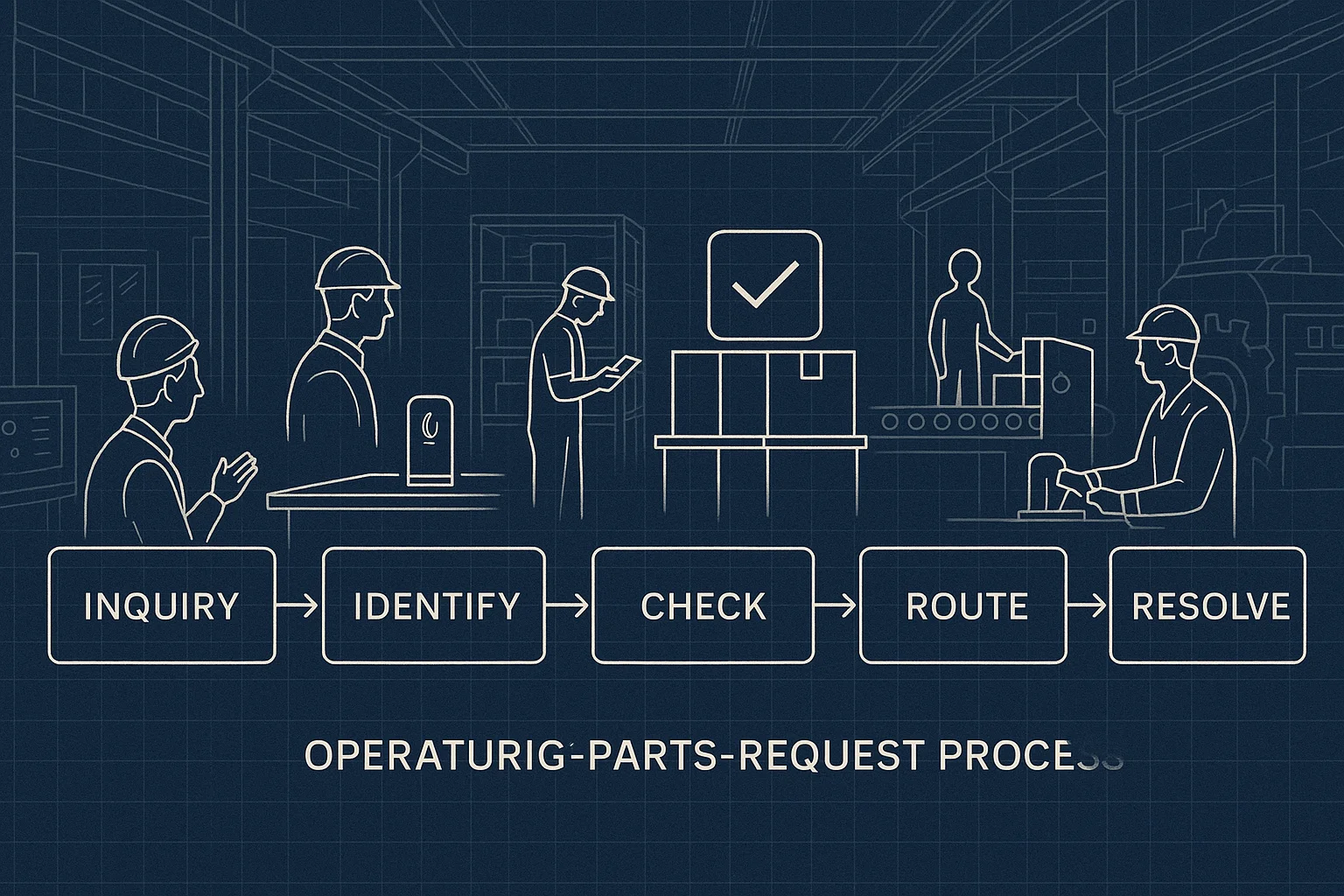
Standardize on a simple, auditable path: Caller → Voice AI → intent and product validation → ERP, CRM, warranty, or service API → case, order inquiry, or specialist handoff. This model ensures every escalation carries a validated intent, product identifier or serial number, warranty status, and business metadata required by downstream systems.
- First-pass: voice-captured metadata plus programmatic validation (ERP/CRM lookup).
- Decision gate: confidence scoring + validation result decides containment or escalate.
- Handoff payload: structured JSON with identity tokens, product ID, warranty flags, transcripts, and audio snippets.
Integration patterns and responsibilities
Separate responsibilities between the Voice AI orchestration layer and enterprise systems. Use controlled adapters and approved APIs for CRM/ERP/warranty lookups and dispatch. That keeps the Voice AI stateless where possible and assigns authoritative decisions to enterprise systems or humans.
- Read-only lookups for validation (ERP/parts catalogs) reduce risk compared with write access.
- Where writes are needed (create a service case or order), require a human approval step for warranty exceptions.
- Define SLA ownership: vendor supplies observability and incident response; manufacturer owns business rules and system-of-record decisions.
Defining Practical QA and Escalation SLAs
Translate operational outcomes into SLA definitions that drive behavior and procurement. Focus SLAs on correctness and end‑to‑end outcomes rather than only on volume or aggregated latency.
Containment quality vs escalation quality
Containment quality measures how correctly Voice AI resolves a caller's need without human help. Escalation quality measures the correctness and completeness of the cases that were escalated. Both require different QA treatments: containment needs end‑state validation, escalation needs handoff verification.
- Containment QA: sample resolved calls, confirm requested outcome was achieved, and verify no hidden follow‑ups were created.
- Escalation QA: confirm case routing, priority, payload completeness (serials, photos), and that the specialist accepted and understood the request.
- Use stratified sampling: priority escalations and warranty calls get higher sampling rates.
SLA definitions you can operationalize
Create SLAs that map directly to measurable events, log entries, and adjudication processes so they are auditable during audits and vendor reviews.
- Containment Rate (by intent group): % resolved by Voice AI validated by QA sample.
- Escalation Accuracy: % escalations adjudicated as correctly routed and complete.
- Average Time-to-Specialist: median time between initiation and specialist acceptance.
- Handoff Completeness Score: composite metric of required fields present in the handoff payload.
QA Instrumentation and Analytics Workflows
The right telemetry, sampling plan, and adjudication workflow make SLAs enforceable. Design for observability, not just data capture.
Instrumentation and sampling
Capture structured events at these points: intent resolved, validation passed/failed, confidence scores, API lookup responses, handoff payload, and specialist acceptance. Use stratified sampling to focus human QA labor where it provides the most value.
- Event streams with immutable timestamps and correlation IDs tie call audio, transcript, and API responses together.
- Sample by intent, confidence, priority, and site to find systemic errors quickly.
- Automate low-risk adjudication (e.g., high-confidence, verified ERP lookup) and route edge cases to human QA.
Analytics that drive improvement
Build dashboards that combine containment, escalation accuracy, rework rate, and time-to-specialist by site, channel, and language. Use root-cause tagging (e.g., NLU mismatch, validation error, ERP data gap, agent routing) to prioritize fixes.
- Trend containment and escalation quality by plant, dealer, and product family to spot systemic data gaps.
- Cross-reference QA failures with integration logs to decide whether fix is UX, model, or data quality work.
- Run monthly SLA reviews with operations, warranty, and IT to close the loop on fixes.

Security, OT Boundaries, and Data Handling
Manufacturing voice projects touch both enterprise IT and operational technology. Protect OT, and control data flows to meet regulatory and contractual obligations while preserving necessary telemetry for QA.
Segmentation and safe adapters
Use strong network and logical segmentation between voice orchestration and OT systems. Implement adapters that perform controlled lookups rather than broad access, and follow OT security guidance when integrating with control networks.
- Deploy voice orchestrators in the IT zone and expose only hardened, rate-limited, read-only adapters to OT systems.
- Use approval gates and human verification for any write operations that might change OT state or production schedules.
- Document remote-access subprocessors, backup regions, and subprocessors in procurement and SSO/identity controls.
Data residency, retention, and privacy controls
Be explicit about where recordings, transcripts, and logs are stored, who can access them, and retention schedules. Flag warranty and safety audio for different retention and access rules and ensure cross-border transfers have legal bases as required by local law.
- Declare hosting region, backup region, and subprocessors in vendor contracts and confirm any cross-border transfer mechanisms.
- Design role-based access controls and separate QA reviewer roles from operational support to limit exposure.
- Confirm recording consent and breach obligations in each jurisdiction with legal counsel; do not rely on platform marketing claims alone.
Multisite Scale, Multilingual Operations, and Governance
Scaling across plants, dealers, and countries requires consistent governance, localized flows, and multilingual support. Plan for configuration management and operator training.
Multilingual and localized workflows
Local language support is not just translation — it requires localized validation rules (part codes, units, warranty terms) and NLP tuning by market. Centralize common intents but allow site-level overrides for local terminology.
- Use language-specific NLU models and local lexicons for parts and serial patterns.
- Central intent definitions with per-site configuration for routing and business rules.
- Consider the operational workflow in 'Multilingual Voice AI for Home Service Companies: Serve More Callers' for capability design and implementation patterns.
Configuration, governance, and site onboarding
Treat each new site or dealer as a controlled release with a runbook: data mappings, ERP/parts catalog checks, test-case list, and a post‑go‑live QA ramp. Use a shared governance board with representation from operations, quality, IT, and dealers.
- Onboarding checklist: connectivity, API keys, catalog sync, sample calls, and rollback plan.
- Governance cadence: weekly during rollout, then monthly SLA reviews with remediation targets.
- Reference operational runbooks and dispatch workflows when designing handoff and escalation patterns to field teams.
Procurement, Rollout Strategy, and Continuous Optimization
Buy for observability and remediation. Contractual SLAs should cover not only availability but also quality metrics, change-management windows, and security obligations.
Procurement checklist
Ask vendors for documented call flows, integration adapters, sample payloads, logging schema, and a remediation SLA for QA failures. Require the ability to extract raw event streams for independent analytics and to perform targeted audits.
- Deliverables: integration adapters, data mapping, test suites, runbooks, and access to event logs.
- Security expectations: subprocessors list, hosting locations, incident response procedures, and segmentation practices.
- Operational expectations: language coverage, escalation routing capabilities, and human-in-loop warranty controls.
Continuous optimization loop
Treat QA findings as the engine for improvement. Feed adjudicated failures back into NLU training, data-catalog corrections, or adapter changes. Prioritize fixes that reduce specialist handoffs or shorten time-to-specialist for safety-critical events.
- Weekly QA-to-ops backlog for high-impact defects, monthly model and rule releases, quarterly SLA and governance reviews.
- Use vendor-supplied analytics together with a manufacturer-maintained BI layer for independent verification.
- Scale improvements by standardizing fixes into templates or configuration packages for regional rollouts.
Related Peak Demand resources
Industry and AI sources reviewed
- Cybersecurity Resources for ManufacturersNIST Manufacturing Extension Partnership
- Guide to Operational Technology SecurityNational Institute of Standards and Technology (NIST)
- Cross-Sector Cybersecurity Performance GoalsCybersecurity and Infrastructure Security Agency (CISA)
Manufacturing cybersecurity, operational-technology, product, warranty, records, and workplace obligations vary by jurisdiction and operating environment. This article is operational guidance, not legal advice; organizations should confirm applicable requirements with qualified professionals.
Frequently asked questions
Strong starting points include parts and order-status requests, distributor or dealer support, warranty and service intake, appointment scheduling, case creation, basic product information, and routing to technical specialists. Keep engineering judgment, safety decisions, and operational-technology control outside the conversational layer.
Official reference: Cybersecurity Resources for Manufacturers
The workflow should collect structured identifiers such as model, serial number, part number, customer account, asset location, and symptoms, then validate them against ERP, CRM, catalogue, warranty, or service systems. The agent should escalate rather than invent a match when confidence is low.
Official reference: Cybersecurity Resources for Manufacturers
Not by default. Customer-service automation should normally use controlled business-system integrations and tightly governed adapters. Any connection near operational technology requires explicit security architecture, least privilege, monitoring, and separation from safety-critical control functions.
Official reference: Guide to Operational Technology Security
Require workflow mapping, integration ownership, test evidence, fallback behavior, auditability, security boundaries, change control, monitoring, human escalation, and a plan for maintaining product, parts, warranty, and service knowledge after launch.
Official reference: Cybersecurity Resources for Manufacturers
Connect Voice AI to real manufacturing service operations
Peak Demand helps manufacturers automate parts, order, warranty, dealer, distributor, and service requests through controlled integrations, validation, escalation, and reporting.
Schedule a discovery call


