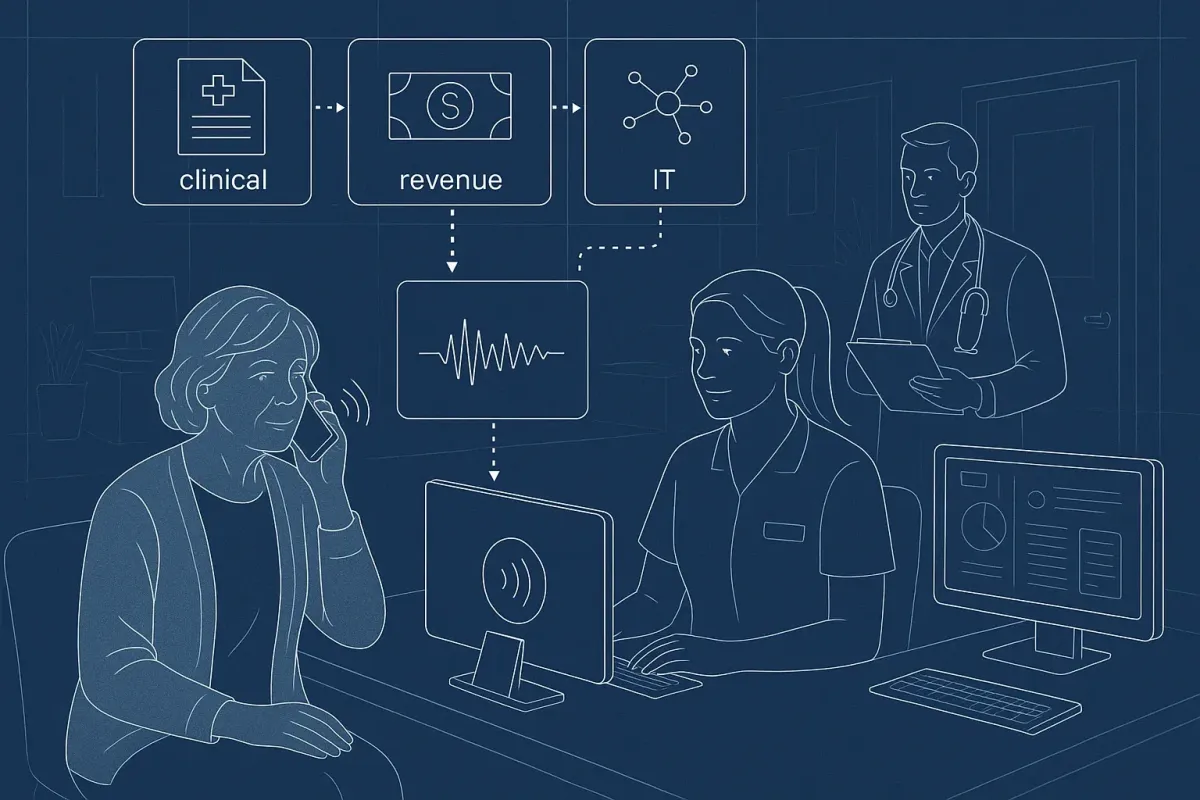
Operating Model for Voice AI‑Led Patient Access: Clinical, Revenue & IT Alignment
A practical operating model for Voice AI in patient access that aligns clinical safety, revenue capture, and IT controls — with integration, governance, escalation, and measurable outcomes.
1. Where Voice AI Belongs in Patient Access
Voice AI can reduce friction in routine administrative interactions, improve after‑hours capture, and standardize intake. But it must be scoped, integrated, and governed to protect clinical safety and revenue integrity.
Use cases that fit
Prioritise administrative and logistic workflows where deterministic rules or simple decision trees suffice. Typical, high-value use cases: appointment booking/rescheduling/cancellation; eligibility and benefits check (pre-scripted verification); reminders and confirmations; simple billing or statement routing; directory and hours queries; and secure information collection for predefined intake forms.
- After-hours appointment capture with automatic reconciliation to normal scheduling windows
- Structured intake for new patients (demographics, reason for visit, payer class) with field validation
- Outbound reminder and confirmation flows with two‑way responses and opt‑out logging
Where Voice AI must not act
Voice AI should never provide clinical assessment, diagnose, prescribe, or triage emergencies. It also must not make final clinical decisions. Any symptom narratives that suggest severity should trigger immediate human escalation according to a preapproved script and handoff.
- Escalate chest pain, severe shortness of breath, active bleeding, altered consciousness, or unstable vitals to emergency dispatch or clinical intake.
- Route ambiguous clinical language to trained nurses or clinicians for live assessment.
- Mark all clinical escalations with timestamps, transcript excerpts, and structured reason codes for audit.
2. A Practical Call Flow and Orchestration
Translate the operating model into a step‑by‑step orchestration. Keep the flow deterministic, auditable, and reversible where possible.
Canonical flow: Patient → Voice AI → Validation → API → Outcome
Design one canonical flow and map variant branches. A minimal, auditable flow looks like: 1) patient call or outbound ring; 2) Voice AI answers, greets, and prompts for intent; 3) Voice AI performs identity checks and captures required structured fields; 4) Voice AI validates fields (policy, payer, appointment slot availability) against the scheduling/EHR APIs; 5) based on validation, Voice AI either confirms the action (booking, cancellation, message logged) or creates an actionable handoff to staff; 6) system logs the transaction, sends confirmation to the patient, and updates the scheduling system.
- Implement deterministic prompts for each required field to avoid open-ended clinical elicitation.
- Use timeouts and confirmed repetitions for critical fields (DOB, phone number, appointment slot).
- Record metadata: call ID, transcript hash, verification level, staff handoff ID, and API transaction IDs.
Validation and identity controls
Enforce identity verification before any PHI exchange or scheduling action. Choices include knowledge‑based questions, one‑time passcodes (OTP) sent to a verified number, or API-based identity checks where available. Store verification level and consent status in the transaction record so downstream systems and staff can see whether the caller was authenticated.
- Require at least one out-of-band verification for high-risk actions (billing changes, cancellations without penalty, or prescription refill requests).
- Persist consent toggles and recording consent decisions in the audit trail.
- Log verification method, timestamp, and whether fallback human verification was used.
3. Integration and Architecture Choices
Integration is where risk and value converge. Use narrow, auditable adapters that map Voice AI intents to scheduling/EHR actions via approved APIs; avoid broad write access without structured validation.
Scheduling and EHR integration patterns
Prefer thin, purpose-built adapters that expose only the necessary scheduling or patient‑management calls. That means separate endpoints for availability read, provisional hold, finalise booking, cancel, and add note. Avoid a single high‑privilege API user that can perform any action. Maintain transactional correlation between the Voice AI session and the scheduling transaction so operations teams can trace and reconcile failures.
- Hold seat pattern: create a provisional hold with expiry; require finalise booking confirmation within the hold window.
- Write‑with‑audit pattern: all writes append a structured note with caller verification level and transcript reference.
- Fail‑safe: if API calls fail, immediately create a human review ticket with the full context and patient contact preference.
Telephony, logging and handoff
Keep telephony, speech transcription, dialogue state, API responses, and human handoff artifacts in a correlated transaction log. This enables root‑cause analysis and regulatory audits. For live transfers, pass structured context — not free‑text — to the agent desktop: intent, captured fields, verification level, and recommended next action.
- Agent desktop should display a single handoff card with recommended scripts and relevant attachments (consent flags, notes, transcript snippet).
- Retain call recordings and transcript hashes according to policy, with access controls for clinical and billing staff.
- Document backup and remote‑support access, subprocessors, and data residency decisions in the architecture annex.
4. Safety, Human Oversight and Escalation
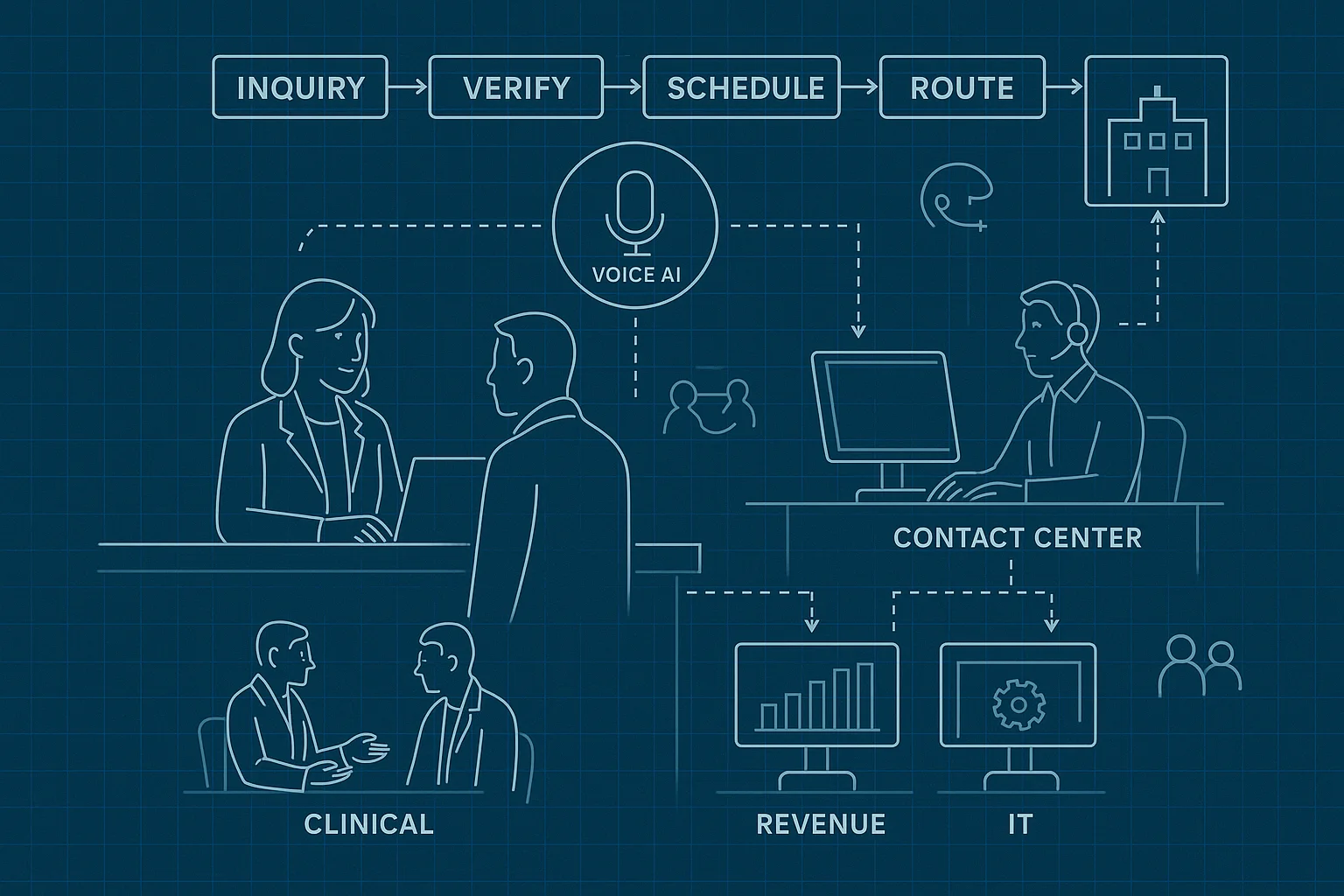
Human oversight is not optional. Define roles, escalation triggers, and audit trails up front. Use human‑in‑the‑loop control points for any non‑deterministic or clinically adjacent decision.
Clinical boundaries and mandatory escalation
Embed explicit trigger lists and closed questions that identify red flags. When a critical trigger is raised, the Voice AI must transfer to a clinically trained resource or follow an approved emergency script. Document these triggers and keep the sequence immutable in the transaction log for audit and training.
- Do not allow intent classification alone to clear a clinical handoff; require explicit match to structured trigger fields.
- Escalations must include a required field for severity, timestamp, and the receiving clinician or unit.
- Keep an 'urgent flag' routing path that bypasses normal queues when necessary.
Human-in-the-loop: state, review and correction
A predictable HIL model reduces risk: the Voice AI can take the first pass on structured administrative tasks, but any exception or record that will materially affect care or billing should land in a human review queue. Provide staff with edit capability, versioning, and visible provenance (what the AI captured, what was edited, and why).
- Use the 'what a human-in-the-loop healthcare AI operating model looks like' playbook to set handoff boundaries and review SLAs.
- Limit the number of queued edits per record to contain manual workload and focus on high‑impact exceptions.
- Track correction rates and common failure modes to feed back into model prompts and rule updates.

5. Governance, Risk Management and Data Controls
Treat Voice AI deployments as socio-technical systems: governance must cover ethical use, legal risk, model reliability, data flows, subprocessors, and monitoring.
Risk management and QA
Implement a documented risk register, scenario testing, and runbooked responses to model drift or systemic errors. Use periodic sampling, simulation of edge cases, and post‑interaction reviews to measure safety and accuracy. Map these activities to an AI risk framework and assign accountable owners.
- Apply an AI RMF‑aligned process for identifying, measuring, and mitigating risks across system lifecycle.
- Maintain a QA pipeline that includes scripted scenarios, live sampling, and continuous metrics for intent accuracy and field validation.
- Have a documented rollback criterion and emergency disable path for the Voice AI channel.
Ethics, regulatory posture, and transparency
Adopt governance practices consistent with internationally recognised AI principles: transparency about AI use, human oversight, and documentation of intended use. Where jurisdictional regulation applies, confirm obligations with qualified legal and compliance advisors. Maintain clear notice to callers when they interact with AI and provide options to speak with staff.
- Publish an internal policy that explains where voice AI is used, what it will and will not do, and how to request human review.
- Log and make available model lineage, prompt templates, and major updates for audit.
- Avoid claims about clinical equivalence or regulatory compliance without documented evidence and appropriate certification.
Data residency, subprocessors and retention
Decide hosting region, backup region, and subprocessors before procurement. Specify cross‑border transfers, processor locations, encryption in transit and at rest, retention periods for recordings/transcripts, and conditions for deletion. Ensure contractual clarity on breach notification timelines and support for regulatory requests.
- Document the geography of primary hosting, backups, and remote support access in contracts.
- Define retention policy per record type (transcript, recording, scheduling transaction) and implement selective redaction capability.
- Require vendors to disclose subprocessors and data transfer mechanisms and provide the right to audit or receive attestations.
6. Procurement, Implementation and Metrics
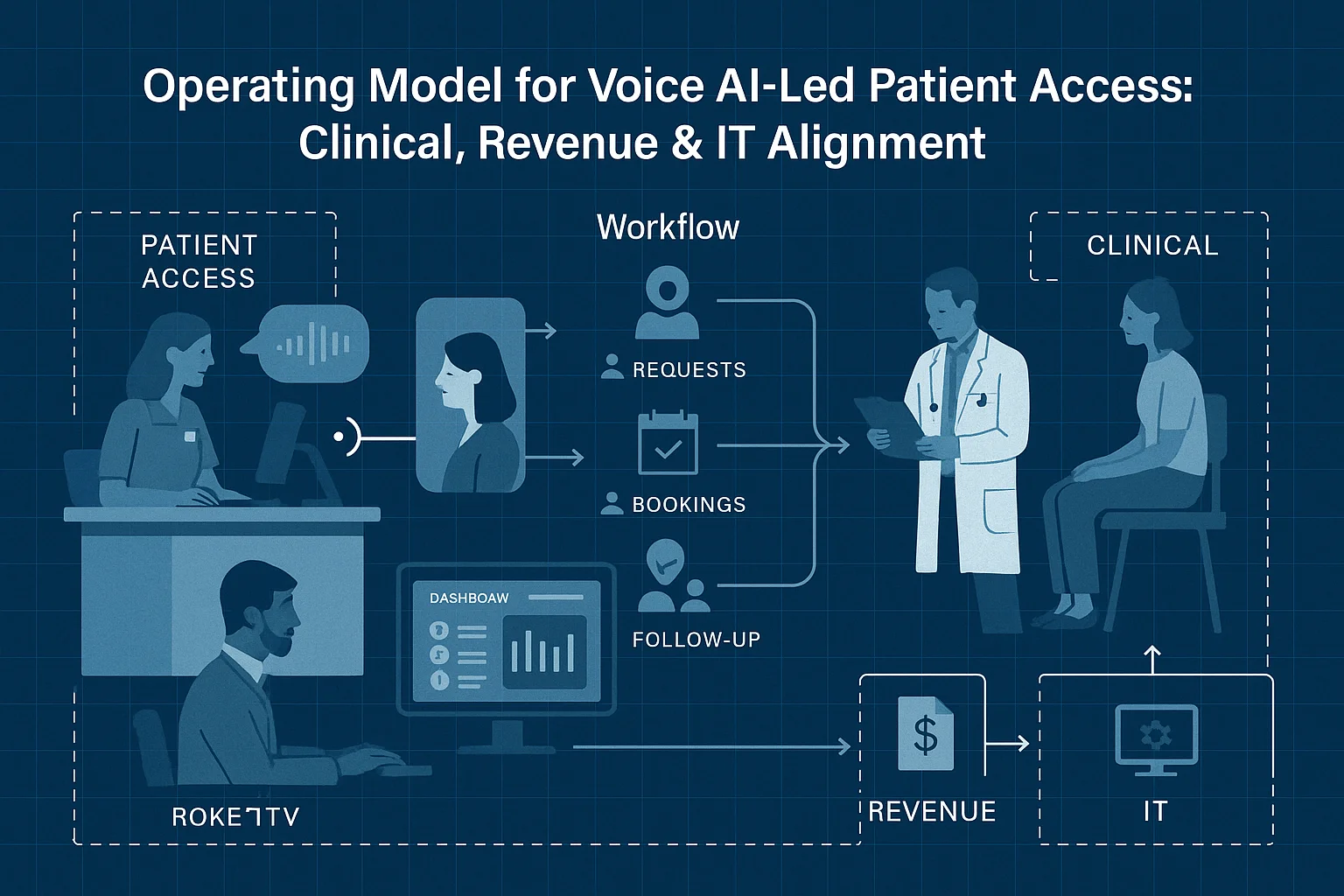
Procurement and implementation decisions determine operational viability. Define requirements for integrations, security, SLAs, and measurable outcomes before signing contracts.
Build vs buy and vendor checklist
Decide build vs buy based on integrations, control needs, and run‑rate. If buying, evaluate vendors for narrow integration adapters, support for identity verification options, audit trail functionality, human handoff controls, and demonstrated experience in healthcare workflows. Insist on clear SLAs for availability, error handling, and patching processes.
- Require demonstration of scheduling/EHR adapter parity for your systems and a staging sandbox for end‑to‑end testing.
- Evaluate vendor ability to implement identity verification and field validation defined in your runbook.
- Check policies for subprocessors, breach response, and access for IT and privacy teams.
KPI framework: measure what matters
Track operational and outcome metrics that align with revenue, patient experience, and safety. Move beyond call answer rate to metrics that show real impact on patient access and revenue recovery.
- Appointment recovery and capture: number of appointments booked or recovered that would otherwise be missed.
- Failed booking reasons: categorized and trended to reduce systemic failures.
- After‑hours capture rate, human review volume, handoff resolution time, and correction rate.
Peak Demand differentiation
When selecting a partner, require proven patterns for custom Voice AI, scheduling and intake integrations, identity verification, field validation, safe escalation, audit trails, and human review. Ensure the partner can deliver narrow, auditable adapters rather than generic write access, and can operationalize human‑in‑the‑loop workflows with measurable SLA-backed review queues.
- Customizable adapters for scheduling and EHR systems with a staging sandbox.
- Integrated identity verification options including OTP and API checks.
- Built-in safe escalation paths, audit logging, and human review tooling.
Related Peak Demand resources
Industry and AI sources reviewed
- Ethics and governance of artificial intelligence for healthWorld Health Organization
- Regulatory considerations on artificial intelligence for healthWorld Health Organization
- Artificial Intelligence Risk Management Framework (AI RMF 1.0)National Institute of Standards and Technology (NIST)
- OECD AI PrinciplesOrganisation for Economic Co-operation and Development
Healthcare privacy, security, clinical-safety, records, and professional obligations vary by jurisdiction and workflow. This article is operational guidance, not legal advice; organizations should confirm applicable requirements with qualified professionals.
Frequently asked questions
Administrative workflows such as appointment booking, changes and cancellations, referral-status intake, approved follow-up, patient-access questions, after-hours overflow, and structured routing are common starting points. Clinical judgment, diagnosis, emergency triage, and prescribing decisions must remain with qualified professionals.
Use the minimum identifiers approved by the organization, validate them against the system of record, avoid exposing unnecessary information, and provide a human-assisted path when verification fails. The system should not infer identity from conversational context alone.
The agent should follow the organization's approved escalation and emergency-routing rules, avoid clinical advice, and transfer or direct the caller to the appropriate human or emergency channel. Those rules must be tested with realistic language and failure cases.
Request identity and privacy controls, scheduling or EHR integration behavior, audit logs, escalation rules, downtime handling, testing evidence, change control, monitoring, and clear separation between administrative automation and clinical decision-making.
Design a safe patient-service workflow before automating it
Peak Demand helps healthcare organizations connect Voice AI to scheduling, intake, patient communication, identity checks, escalation, and reporting with clear operational boundaries.
Schedule a discovery call


