
Measuring Healthcare Voice AI: Booking Completion, Escalation, and Patient Access Outcomes
A practical measurement and operating guide for healthcare teams deploying Voice AI for patient access. Defines KPIs, audit workflows, identity and scheduling controls, safe escalation, procurement evidence, and governance boundaries.
1. Why measure Voice AI by outcomes, not answer rates
Healthcare patient access teams commonly evaluate phone systems by call answer rate or average handle time. For Voice AI that books appointments and routes clinical questions, those telephony metrics miss three critical outcomes: whether an appointment was actually created and confirmed, whether urgent or clinical issues were safely escalated, and whether overall patient access improved.
Booking completion over call completion
Define booking completion as a confirmed, accepted appointment that appears in the practice management or EHR booking system and triggers downstream confirmation (SMS, email, or a human confirmation step when used). Measuring booking completion requires matching the Voice AI call outcome to the scheduling system transaction—success is not just the AI saying “booked,” but the presence of an immutable scheduling record or a documented reservation token.
- Measure two variants: Direct Booking Completion (transaction posted to scheduling API) and Reservation-to-Confirm Completion (reservation created; human confirmation pending).
- Track conversion to confirmed appointment within a fixed window (e.g., 24–72 hours) for reservation flows.
Escalation quality beats quantity
Escalation metrics should capture whether the right calls were escalated, whether escalation happened within the required time, and whether escalation preserved contextual data (reason codes, audio transcript, intent metadata) to minimise repeat collection. Avoid simple counts—measure false-positive escalations (unnecessary human handoffs) and false-negatives (missed urgent cases).
- Record escalation precision = escalated calls that required human intervention / total escalated calls.
- Record escalation recall = escalated urgent cases / total urgent cases identified in human audit.
- Log contextual payloads and timestamps to enable post-event review.
Patient access outcomes: appointment recovery and rework
Patient access outcomes measure system-level patient experience and capacity impact: appointment recovery (requests captured after-hours or during high volume), rework for staff (manual correction or duplicate bookings), and time-to-confirmation. These outcomes tie Voice AI performance to operational KPIs such as daily scheduled volume and front-desk workload.
- Appointment recovery = appointments captured by Voice AI outside staffed hours or after a missed call and ultimately confirmed.
- Staff rework = manual corrections per 100 bookings or manual touches required to complete a Voice AI transaction.
2. Core KPIs and how to define them
Select a compact KPI set that answers three questions: did the patient get an appointment or access they needed; was clinical risk managed safely; and did the system reduce manual workload without creating hidden work?
Primary KPIs to operationalise
Use a small core of outcome KPIs and instrument them with clear event definitions backed by system signals and human audit.
- Booking Completion Rate = confirmed bookings / booking attempts (direct and reservation paths counted separately).
- Escalation Accuracy = true-positive escalations / total escalations.
- Appointment Recovery Rate = recovered appointment requests / missed-call or after-hours call volume.
- Staff Rework per 100 Bookings = manual touches required to resolve Voice AI-created bookings.
Support KPIs and observability
Support KPIs provide leading indicators and troubleshooting data for operations and vendor governance.
- Intent accuracy (operator- or human-annotated sample), latency (end-to-end time to booking), transaction error rate (API failures), and fallback rate (calls routed to IVR or.
- Quality-of-handoff metrics: percentage of escalations with full context (intent, audio, transcript, metadata).
3. Operating model and transaction design
Design choices at the transaction boundary materially affect safety, privacy, and measureability. Be explicit about identity checks, booking modes, and how the Voice AI interacts with scheduling systems.
Canonical architecture
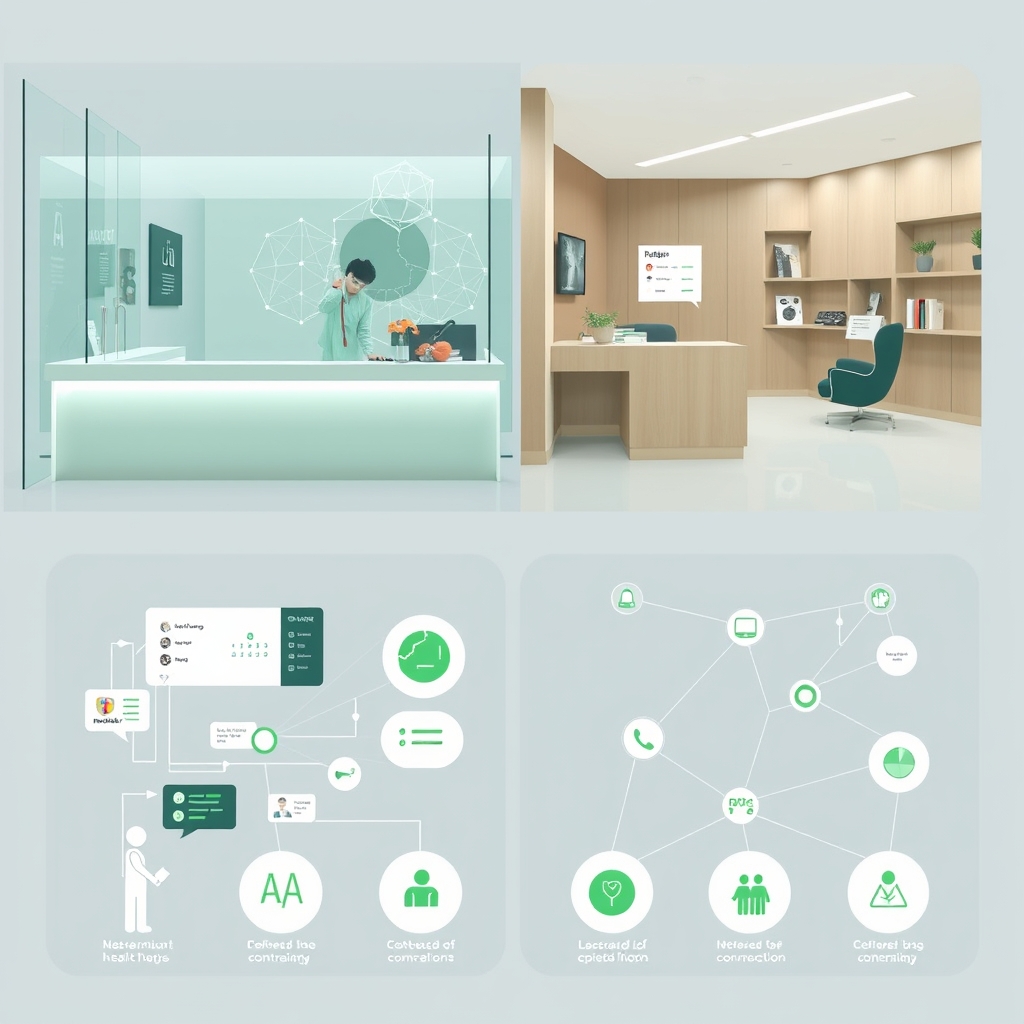
Adopt a simple, auditable flow: Patient or caller → Voice AI → validation and identity controls → approved scheduling or service API → confirmation or human handoff. This flow must preserve an audit trail for every decision and API call.
- Persist event records and IDs (call ID, dialogue ID, scheduling transaction ID) to correlate recordings, transcripts, and scheduling records.
- Ensure each booking action has an idempotent transaction token to avoid duplicates during retries.
Identity and validation controls
Identity controls protect privacy and prevent false bookings. Choose controls that balance friction and safety: caller-provided identifiers (patient ID, DOB), one-time passcodes (OTP) to the patient’s recorded number, or short knowledge-based questions. Avoid over-reliance on remote biometric verification without legal and privacy review.
- Define minimum identity proofing for different transaction sensitivity levels (e.g., appointment change vs. controlled-substance prescription requests).
- Log verification method and success/failure events in the audit trail.
Booking modes and their measurement implications
Decide between direct transactional booking (Voice AI calls scheduling API to create an appointment) and reservation workflows (Voice AI takes details and creates a queue or reservation token for human confirmation). Both are valid but require different controls and KPIs.
- Direct booking requires robust transactional guarantees, API back-off strategies, and immediate confirmation to the patient.
- Reservation flows reduce automation risk but require tracking conversion within an agreed SLA (e.g., 24 hours) and should be instrumented as a separate KPI.

4. QA, audit pipelines and human-in-the-loop governance
Quality assurance should verify both technical accuracy and safe outcomes. A structured audit pipeline, continuous sampling, and human-in-the-loop controls close the loop between measurement and operating change.
Call-outcome auditing and sampling
Implement a stratified sampling plan that includes successful bookings, failed bookings, escalations, and random calls. Annotate samples with ground-truth outcomes (human review of transcript + schedule verification) to compute KPI denominators like true urgent events and booking fidelity.
- Sample size and frequency should reflect risk: higher for clinical escalation paths and after safety changes.
- Automate sample selection and store reviewer annotations as structured metadata to feed dashboards and ML improvements.
Human-in-the-loop operating model
Define explicit decision boundaries where Voice AI acts, where it suggests actions, and where humans must decide. Maintain review queues, SLAs for human review, and playbooks for ambiguous cases.
- Use confidence thresholds to gate automated bookings—low-confidence flows route to clinician or intake staff.
- Record whether a human accepted, modified, or rejected the AI action and why; use this data in retraining and QA cycles.
Continuous improvement and feedback loops
Feed QA annotations, transaction failures, and root-cause classifications back into dialogue models, intent classifiers, and transaction middleware. Prioritise fixes that reduce rework and improve escalation precision.
- Track remediation lead time (time from identified issue to deployed fix) and its effect on KPIs.
- Maintain a suppression list for known benign utterances that previously caused false escalations.

5. Governance, risk management and safety boundaries
Voice AI in healthcare requires documented governance: who decides thresholds, who owns incident response, and where the clinical boundary lies. Use established AI risk and ethics guidance to set these structures.
AI governance and risk frameworks
Map your governance to accepted frameworks: risk assessment and controls for safety, explainability, and auditability. Use these frameworks to formalise acceptance criteria for production changes and to document residual risks.
- Adopt a documented risk register for Voice AI features and update it after each change.
- Use NIST AI RMF practices for risk management, including monitoring and post-deployment evaluation.
- Apply WHO and OECD principles to ensure human oversight and transparency for health-related AI.
Clinical safety boundaries
Voice AI for patient access must explicitly exclude clinical decision-making: never diagnose, triage emergencies, prescribe, or replace clinician judgment. Escalate any clinical-sounding utterance to qualified staff and log the escalation with full context.
- Define and publish prohibited actions and enforce them programmatically—use intent rules and confidence thresholds to trigger immediate handoff.
- Train staff on scenario-based handoffs and preserve verbatim transcripts for post-event review.
Data residency, subprocessors and privacy controls
Treat data residency, recording, and subprocessors as contractual controls. Specify hosting region, backup region, subprocessors, retention periods, recording consent requirements, and breach-notification duties in procurement documents. Avoid assuming jurisdictions require a single hosting model—confirm obligations with legal counsel.
- Contractually require vendor disclosure of subprocessors and transfer mechanisms for cross-border processing.
- Document where recordings are stored, retention duration, encryption-at-rest and in transit, and controls for remote-support access.
6. Procurement and operational evidence
Procurement should secure operational evidence and controls that let teams measure outcomes and hold vendors accountable. The contract is where measurement becomes enforceable.
Contract clauses that matter
Ask for explicit SLAs and reporting obligations that align to your KPIs: booking completion SLAs, escalation integrity, API error rates, data residency commitments, and audit access. Require a right-to-audit for security and quality processes.
- Specify reporting cadence and formats (daily or weekly dashboards with raw event exports for independent audit).
- Include breach-notification timelines, subprocessors lists, and remediation commitments.
Operational runbook and incident management
Demand an operational runbook that covers degraded modes, failover to human agents, incident escalation, and rollback criteria for behavioural changes. Test the runbook via scheduled failure drills and include runbook performance in vendor reviews.
- Define degraded-mode behaviour: if scheduling API fails, route calls to queue for human follow-up and log reservations with TTL.
- Require vendor participation in tabletop exercises for escalations involving clinical risk.
Evidence for procurement evaluation
Evaluate vendors on measurable evidence, not marketing claims: provide anonymised event exports, sample audit reports, details on verification methods, and observed KPI trajectories in pilot phases.
- Request a pilot that produces measurable booking completion and escalation precision results on production-like traffic.
- Require evidence of reproducible test cases for boundary scenarios (e.g., ambiguous DOB, multiple callers, API timeouts).
Related Peak Demand resources
Industry and AI sources reviewed
- Ethics and governance of artificial intelligence for healthWorld Health Organization
- Artificial Intelligence Risk Management Framework (AI RMF 1.0)National Institute of Standards and Technology (NIST)
- OECD AI PrinciplesOrganisation for Economic Co-operation and Development
- Regulatory considerations on artificial intelligence for healthWorld Health Organization
Healthcare privacy, security, clinical-safety, records, and professional obligations vary by jurisdiction and workflow. This article is operational guidance, not legal advice; organizations should confirm applicable requirements with qualified professionals.
Frequently asked questions
Administrative workflows such as appointment booking, changes and cancellations, referral-status intake, approved follow-up, patient-access questions, after-hours overflow, and structured routing are common starting points. Clinical judgment, diagnosis, emergency triage, and prescribing decisions must remain with qualified professionals.
Use the minimum identifiers approved by the organization, validate them against the system of record, avoid exposing unnecessary information, and provide a human-assisted path when verification fails. The system should not infer identity from conversational context alone.
The agent should follow the organization's approved escalation and emergency-routing rules, avoid clinical advice, and transfer or direct the caller to the appropriate human or emergency channel. Those rules must be tested with realistic language and failure cases.
Request identity and privacy controls, scheduling or EHR integration behavior, audit logs, escalation rules, downtime handling, testing evidence, change control, monitoring, and clear separation between administrative automation and clinical decision-making.
Design a safe patient-service workflow before automating it
Peak Demand helps healthcare organizations connect Voice AI to scheduling, intake, patient communication, identity checks, escalation, and reporting with clear operational boundaries.
Schedule a discovery call


