
Designing Safe Voice AI Handoffs for Clinics and Health Systems
Practical guidance for designing Voice AI handoffs that preserve safety, privacy, and operational control in clinics and health systems—covering identity, integrations, escalation, QA, and procurement.
1. Why safe handoffs matter now
Voice AI is being adopted to reduce missed calls, shorten hold times, and automate routine scheduling. For clinics and health systems, the technical promise is real—but the operating risk is concentrated at the moment of handoff: when an automated interaction must change a patient’s record or schedule an appointment.
Operational and patient-safety risks
A failed or unauthorised handoff can create missed or duplicate appointments, privacy exposures, incorrect patient routing, or delayed escalation for urgent conditions. Operational disruption is most apparent in high-volume clinics where scheduling calls already disrupt in-clinic workflows; designing safety controls up front reduces downstream triage and rework.
- Incorrect scheduling or double-booking increases no-shows and staff rework.
- Weak identity controls expose patient data and complicate consent.
- Unclear clinical boundaries risk inappropriate advice or missed urgent escalation.
Why design discipline matters for enterprise buyers
Health systems buy integrations, not novelty. Buyers should require clear ownership for each integration point, testable failure modes, and contractual obligations for audit logs and human-review workflows. Operationally, Voice AI is most valuable when it removes repetitive administrative work but preserves traceability and controlled human intervention.
- Specify who owns each adapter (voice vendor, integrator, or clinic IT).
- Require test fixtures and rollback paths for scheduling APIs.
- Insist on transaction-level audit trails and retrievable recordings.
2. A practical, non-clinical use case and architecture
Focus on a narrow, measurable use case: appointment intake (new booking, reschedule, or cancellation) for non-urgent visits. This preserves value and reduces risk compared with broader clinical automation.
Canonical transaction flow
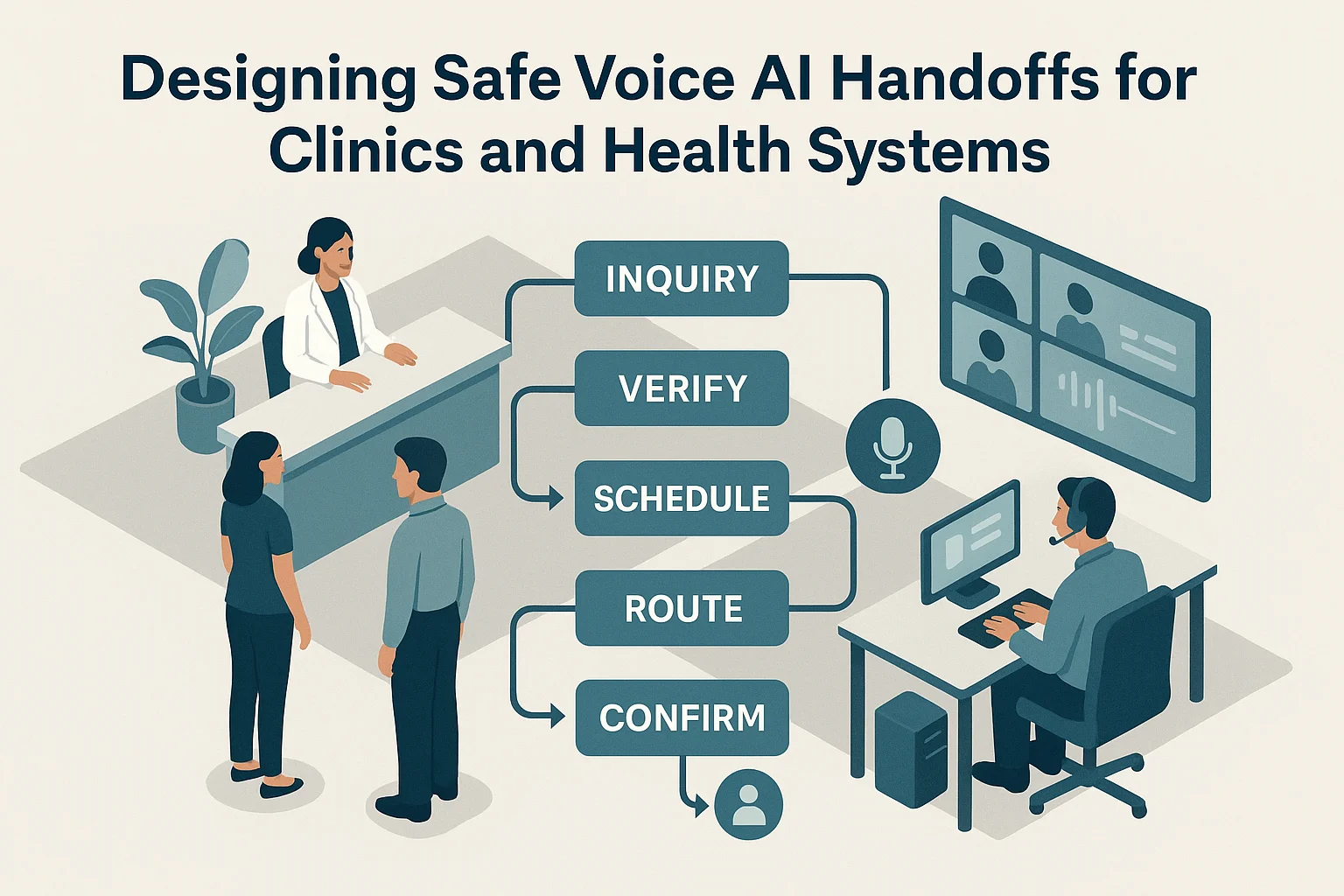
Design the handoff as a guarded sequence: Patient or caller → Voice AI intake → identity & context validation → pre-authorized action via an approved scheduling/service API → confirmation or human handoff. Every step emits an auditable event and an operator-visible summary.
- Step 1: Capture caller intent, appointment parameters, and urgency flags.
- Step 2: Validate identity (callback, token, or knowledge-based verification).
- Step 3: Request authorization to act (session token tied to a patient record).
- Step 4: Execute an idempotent scheduling API call and record transaction details.
- Step 5: Provide confirmation to the patient and create a human review ticket if needed.
Where Peak Demand differentiation is operational
In procurement and implementation, distinguish vendors that provide only conversational engines from those that deliver custom Voice AI plus scheduling and intake integrations, identity verification, field validation, safe escalation, audit trails, and human-review tooling. Require explicit adapters for each EHR/PM system rather than brittle screen-scraping.
- Custom Voice AI integrated to scheduling systems reduces error-prone mediations.
- Field validation (confirm clinic hours, provider availability) prevents invalid bookings.
- Integrated audit trails and human review reduce liability and operational friction.
Further reading
These articles explain the operational context for multi-location networks and the costs of scheduling calls:
- How Multi-Location Healthcare Networks Handle Patient Communication — practical coordination patterns.
- How Scheduling Calls Disrupt Clinics — why scheduling is a prime automation target.
3. Identity, validation, and privacy controls
Make identity validation mandatory for any action that creates, modifies, or cancels appointments or accesses protected health information. Design multiple, layered controls so no single weak factor authorises a transaction.
Layered identity and session binding
Combine session-based tokens, callback confirmation, and challenge-response for higher-risk transactions. For example, low-risk requests (hours, clinic directions) can be completed without deep identity checks; scheduling or access to PHI requires session binding to a known patient account and a second verification factor.
- Session token issued at call start, tied to call metadata and device fingerprint where available.
- Callback or SMS OTP for changing appointments or viewing PHI.
- Knowledge-based checks reserved for fallback when other verifiers are unavailable.
Privacy, data residency, and consent
Document where audio is processed, which subprocessors handle the data, whether recordings are stored, and the retention policy. Distinguish hosting region, backup region, and remote-support access. Confirm data-transfer mechanisms and retention terms during procurement and with legal counsel—jurisdictional obligations vary and should be validated with qualified professionals.
- Clarify hosting and backup regions and any subprocessors with remote access.
- Document recording consent prompts and opt-out flows for callers.
- Define retention windows for recordings and structured logs versus transactional metadata.
4. Clinical boundaries, escalation, and safety
Voice AI in patient access must have explicit, auditable boundaries so it never substitutes for clinical judgement. Escalation to trained staff should be fast, reliable, and measured.
Define non-clinical vs clinical intents
Classify intents before deployment. Allow Voice AI to handle administrative intents (appointment creation, reminders, directions, basic eligibility questions) but block clinical advice, diagnosis, triage, medication changes, or any request that requires clinical judgment.
- Whitelist administrative intents and deny or transfer all others.
- Continuously evaluate intent-recognition thresholds against labeled test sets.
Escalation triggers and fast human routes
Define explicit triggers that create a live handoff or priority callback: ambiguous intent, high urgency keywords, failed identity verification, patient distress indicators, or when the system’s confidence drops below a threshold. Operationally, provide a one-touch escalation path and surface relevant call context to the receiving clinician or staff member.
- Automatic priority queue creation for urgent flags with SLA commitments for response time.
- Context packet includes transcript, confidence scores, identity verification result, and attempted actions.

5. Integration, transaction safety, and auditability
Protect the transaction boundary between Voice AI and clinical systems with approved APIs, idempotent operations, and robust logging so every action is reversible or auditable.
Approved APIs and adapter ownership
Require the use of vendor-supported or clinic-approved APIs into scheduling/EHR/PM systems. An integration contract should name the adapter owner and define failure handling (retries, dead-letter queues, and human-visible rollback). Avoid ad hoc screen-scraping or fragile UI automation as the primary integration path.
- Idempotent scheduling calls reduce duplicate bookings on retry.
- Define retry limits, backoff, and escalation when API errors persist.
- Design a dead-letter pathway that flags transactions for manual reconciliation.
Transaction logging and audit trails
Log each step: voice intake ID, identity verification result, decision logic version, API request and response, timestamps, and operator annotations. Ensure logs are immutable, searchable, and retained per policy for incident review and regulatory inquiry.
- Store transcripts (if retained) separately from structured transaction logs for privacy controls.
- Make audit events available to compliance teams and for periodic QA sampling.
- Include a tamper-evident seal or cryptographic integrity check for critical records.
Service pages and clinic contexts
Design integrations differently for 24/7 after-hours handling versus in-hours operator augmentation. For example, after-hours systems should emphasize safe escalation to an on-call clinician or emergency instructions rather than broad scheduling capability.
- Use narrower capability sets for after-hours automation and route clinical issues immediately.
- Match integration depth to the clinic type (e.g., women’s health clinics often require specific intake fields and routing).
6. Reliability, QA, and procurement considerations
Operational success depends on observability, targeted QA, and procurement practices that assign integration responsibility and measurable acceptance criteria.
Operational metrics and failure boundaries
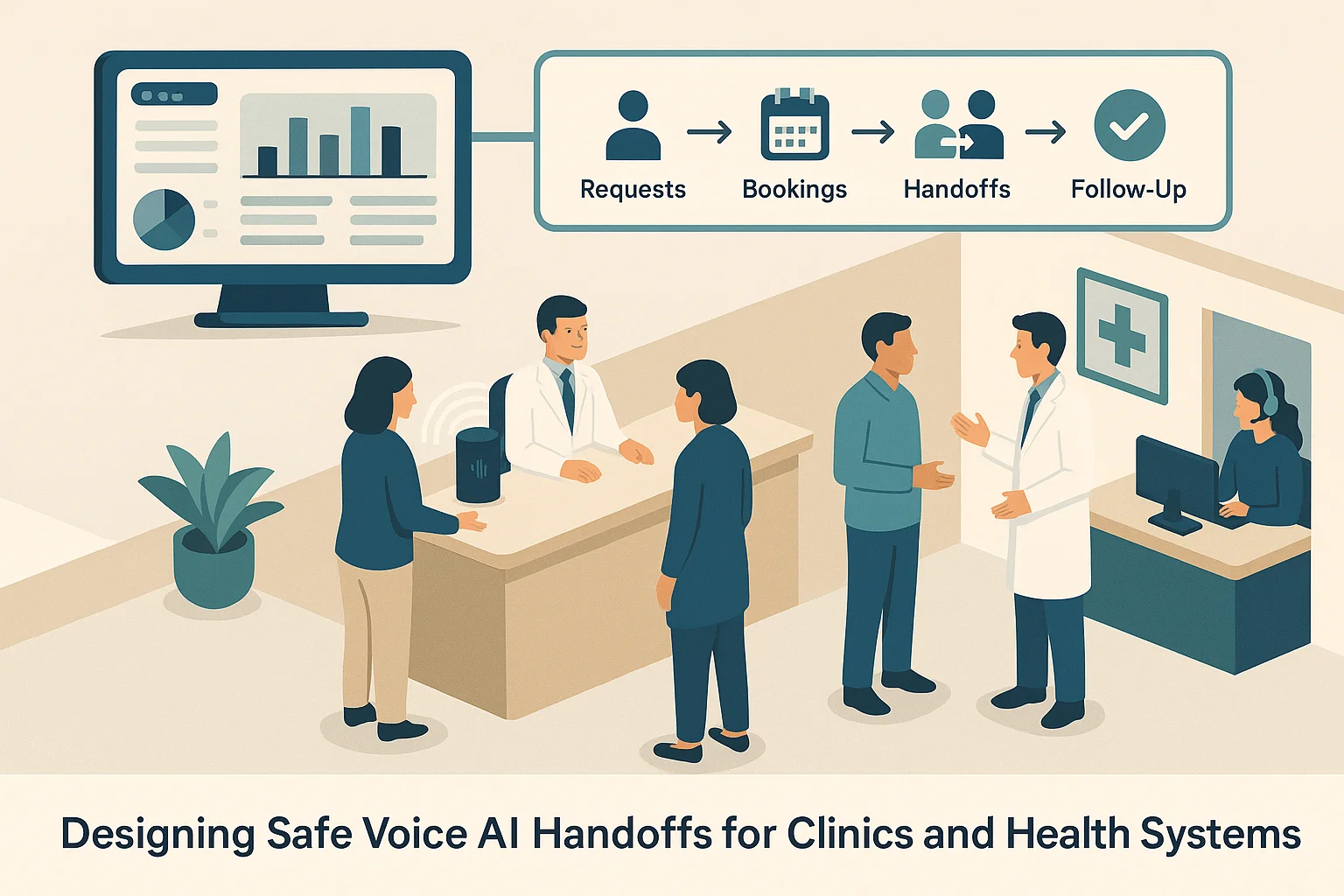
Track a small set of high-signal metrics and enforce failure budget rules: handoff success rate, escalation rate, mean time to human answer for escalations, false-action rate (actions that required manual reversal), and identity-failure rate. Use synthetic tests that exercise provider calendars, blackout times, and capacity constraints.
- Define acceptable thresholds and runbooks for when metrics drift.
- Maintain synthetic daily tests that emulate bookings, reschedules, and cancellations across clinics.
Procurement evidence and vendor evaluation
Require vendors to provide: integration diagrams, subprocessors list, data-flow maps, test suites, audit log format, SLA for escalations, and a written human-review process. Include contractual clauses requiring notification for subprocessor changes, support region definitions, rollback assistance, and periodic third-party audits.
- Insist on clearly defined ownership for each adapter and for security patches.
- Ask for sample audit logs and a red-team or QA report for intent-classification errors.
Related operational reading
Additional Peak Demand material on agent roles and surge behaviour provides context for procurement and capacity planning.
- Internal vs Patient-Facing Agents in Healthcare Communication
- What Breaks First When Patient Demand Surges
7. Implementation checklist and rollout plan
A pragmatic checklist reduces risk during pilot and scale phases. Use phased rollouts with clearly defined success criteria and stop conditions.
Minimum controls checklist
Before pilot: narrow scope (scheduling only), identity & session binding enabled, approved API adapters assigned, escalation routes tested, logging enabled, and QA test suite passing across representative clinics.
- Scope: non-urgent appointment intake only.
- Identity: session tokens + second factor for actions on PHI.
- Integration: vendor-provided adapter with idempotency and rollback path.
- Safety: defined escalation triggers and priority routes.
- Observability: live dashboards for handoff success and escalations.
Pilot, evaluate, and scale
Run a timeboxed pilot with measurable KPIs and post-pilot audit. If key metrics (handoff success, false-action rate, escalation latency) meet targets, expand incrementally by clinic type and provider specialty. Maintain continuous QA sampling and semi-annual governance reviews.
- Pilot length: 6–12 weeks depending on call volume.
- Sample each day for manual transcript review and human-reversal counts.
- Scale by adding clinics with similar appointment complexity first.
Related Peak Demand resources
Industry and AI sources reviewed
- Ethics and governance of artificial intelligence for healthWorld Health Organization
- Regulatory considerations on artificial intelligence for healthWorld Health Organization
- Artificial Intelligence Risk Management Framework (AI RMF 1.0)National Institute of Standards and Technology (NIST)
- OECD AI PrinciplesOrganisation for Economic Co-operation and Development
Healthcare privacy, security, clinical-safety, records, and professional obligations vary by jurisdiction and workflow. This article is operational guidance, not legal advice; organizations should confirm applicable requirements with qualified professionals.
Frequently asked questions
Administrative workflows such as appointment booking, changes and cancellations, referral-status intake, approved follow-up, patient-access questions, after-hours overflow, and structured routing are common starting points. Clinical judgment, diagnosis, emergency triage, and prescribing decisions must remain with qualified professionals.
Use the minimum identifiers approved by the organization, validate them against the system of record, avoid exposing unnecessary information, and provide a human-assisted path when verification fails. The system should not infer identity from conversational context alone.
The agent should follow the organization's approved escalation and emergency-routing rules, avoid clinical advice, and transfer or direct the caller to the appropriate human or emergency channel. Those rules must be tested with realistic language and failure cases.
Request identity and privacy controls, scheduling or EHR integration behavior, audit logs, escalation rules, downtime handling, testing evidence, change control, monitoring, and clear separation between administrative automation and clinical decision-making.
Design a safe patient-service workflow before automating it
Peak Demand helps healthcare organizations connect Voice AI to scheduling, intake, patient communication, identity checks, escalation, and reporting with clear operational boundaries.
Schedule a discovery call


