
Designing Reliable Tool Use for Voice AI Agents
A practical architecture and operations guide for reliable, auditable, and cost-effective tool use in enterprise Voice AI. Covers MCP servers, logic bridges, QA, containment, escalation, multi-site scale, and measurable outcomes.
Architecture overview: responsibilities and flow
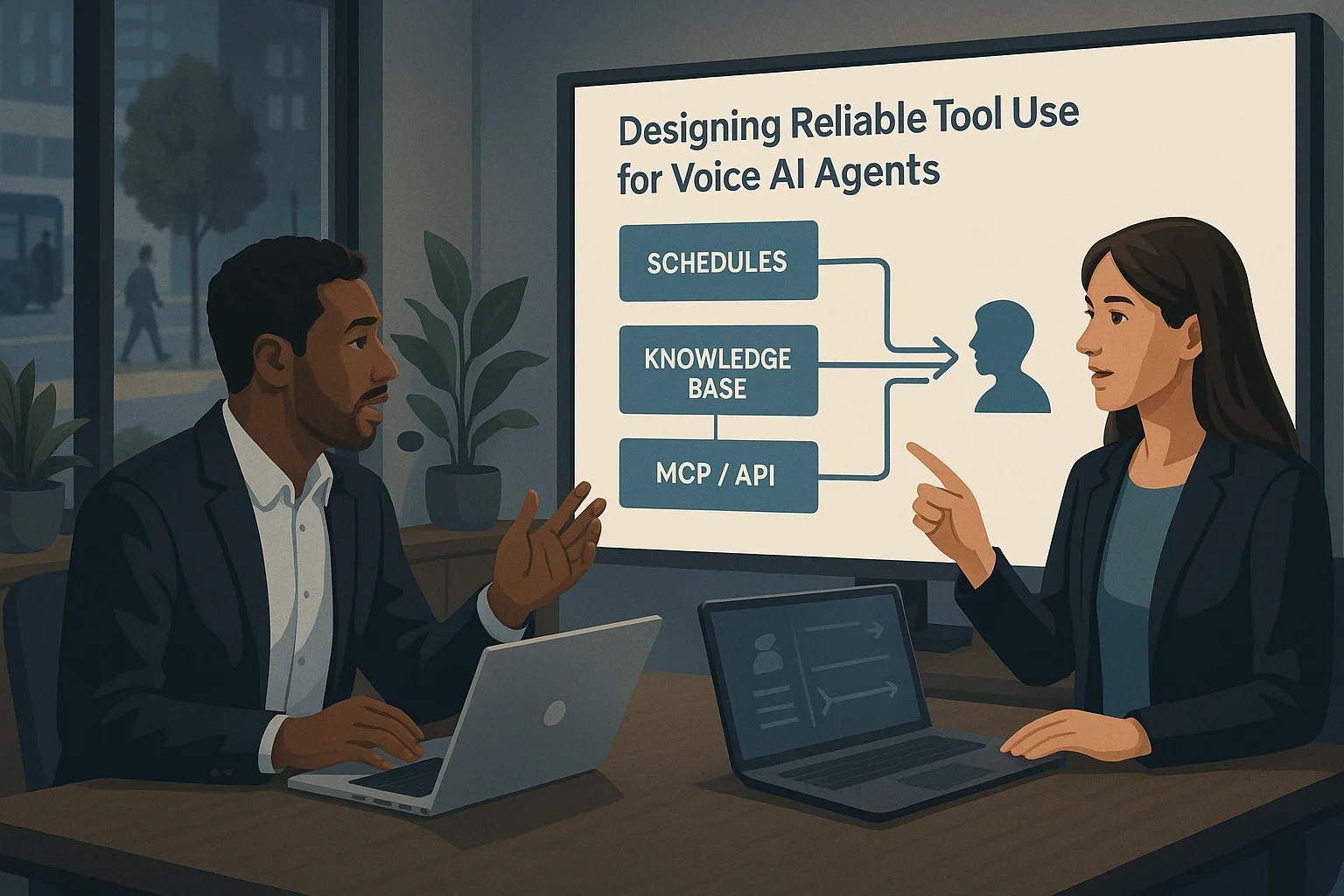
A pragmatic enterprise architecture separates reasoning (the agent and model) from policy, validation, and action. This reduces blast radius, provides auditability, and creates clear procurement and operational boundaries.
MCP defined and its concrete role
Define MCP as Model Context Protocol. MCP supplies the model with context payloads (customer data snippets, sanitized session state, policy tags, and schema definitions) and exposes model-facing tools in a normalized, versioned schema. MCP is not the underlying business API or data source; instead it is the model’s interface: a controlled contract that maps model tool calls to real-world APIs through the orchestration layer. MCP servers host schema registry, tokenized context envelopes, and a light execution sandbox that records intent and enforces metadata (e.g., retention TTL, purpose tags).
Operational flow (explicit)
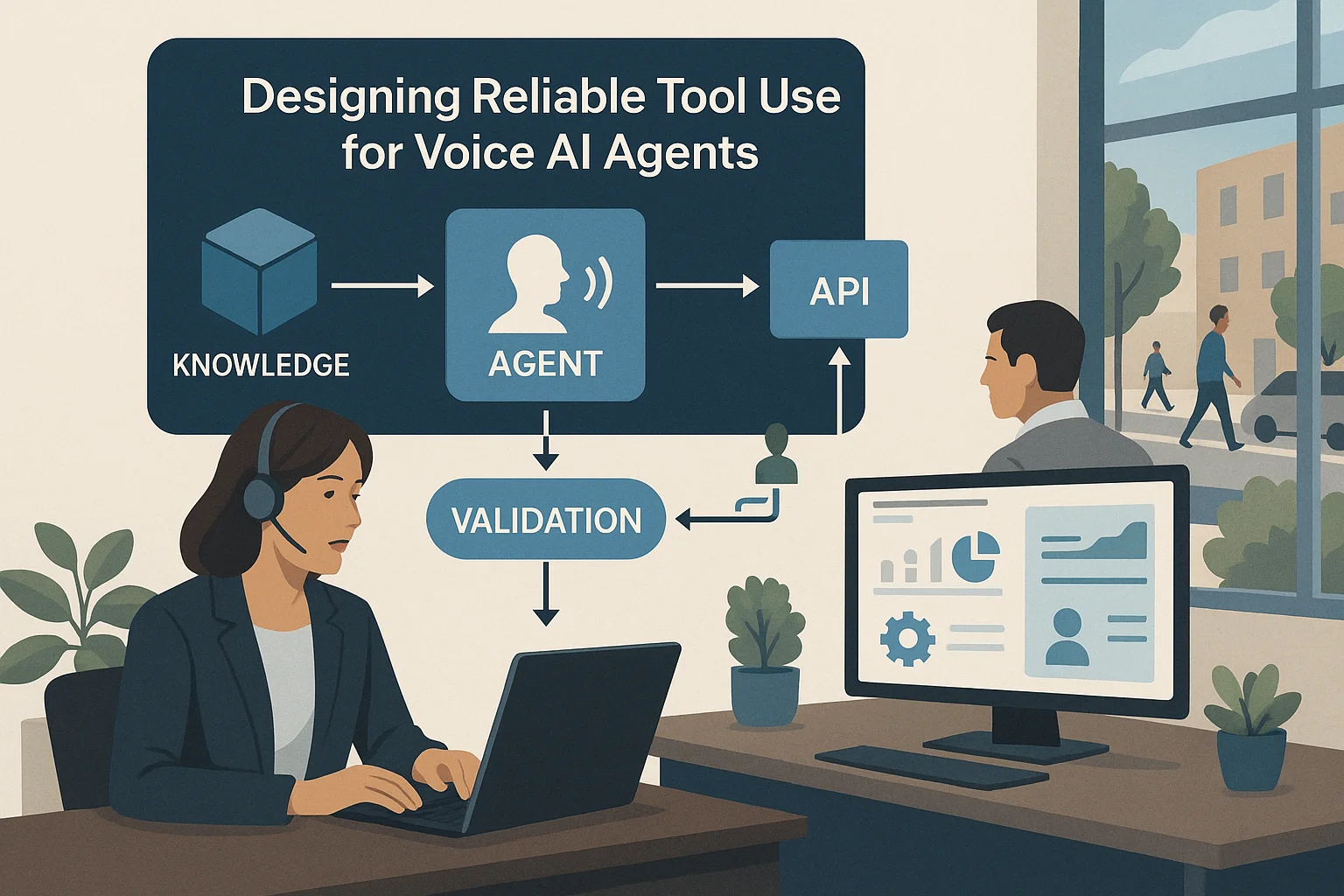
User interaction → AI agent (reasoning, prompt, tool choice) → policy and logic bridge (validation, enrichment, idempotency check) → MCP tools/API orchestration (schema normalization, rate limits, routing) → validated system action (API call, database update, message) → audit event and human fallback. Each arrow is an enforced boundary: only signed, schema-conformant requests flow downstream; every action emits an audit record and a human-review token when risk thresholds are crossed.
- Enforce signed requests between bridge and MCP to prevent lateral model access.
- Treat the MCP payload as ephemeral: store context for the minimum required retention and log an immutable audit entry.
- Human fallback tokens contain minimal context and an action summary to avoid exposing raw PII while enabling rapid review.
Policy and logic bridge: control plane for tool use
The policy-and-logic bridge is the system of record that codifies business rules, safety checks, and escalation logic. It is a microservice or set of microservices that never delegates unchecked authority to a model.
Policy enforcement and validation
Implement policy checks as code-backed rulesets (feature flags, dynamic policies) that run before any MCP API invocation. Validation should include schema conformance, field-level sanitization, consent and retention checks, and purpose tags. Policies must be testable: maintain a deterministic test harness that can simulate model tool outputs and verify policy decisions.
- Fail closed: if validation is inconclusive, return a safe fallback (human review or read-only response).
- Record why a decision was made (policy id, rule version, input hash) to support QA and audits.
- Keep policy rules externalized to allow rapid updates without model retraining.
Tool selection, idempotency and controlled effects
Treat model tool calls as intent statements, not immediately-executed operations. Use a two-phase commit pattern: 1) model requests a tool action with an operation descriptor and nonce, 2) bridge validates and reserves resources, 3) MCP executes with idempotency keys, and 4) bridge confirms outcome and emits an audit record. Idempotency keys prevent duplicate side effects when calls retry or when a model reissues the same operation.
- Normalize all tool contracts into well-defined verbs (e.g., create-appointment-v1) and required fields.
- Apply optimistic concurrency controls for conflicting updates across concurrent calls.
- Expose only a narrow set of actions to the model; all write-capable actions should require an idempotency key and operator signature when risk is.
MCP servers, API orchestration, and schema normalization
MCP servers act as the model’s trusted runtime: they map model-facing tools to business APIs while enforcing schema, rate limits, and routing. Proper orchestration reduces integration complexity and makes multi-vendor APIs consistent.
Schema registry and normalization
Maintain a versioned schema registry that the MCP serves to the model at session initiation. Normalize heterogenous business APIs into canonical models (e.g., appointment, order, account) and provide transformation adapters. Normalization minimizes prompt engineering drift and reduces downstream validation errors.
- Ship small, backwards-compatible schema updates and track consumer adoption.
- Provide JSON Schema or Protobuf definitions and a sample-value dataset for QA.
- Log transformation diffs for every call so QA can replay model→tool translation.
Orchestration, retries, and rate limiting
Implement orchestration policies: retries with exponential backoff, circuit breakers for failing endpoints, per-tenant rate limits, and traffic shaping for language or site-level spikes. Orchestration also handles routing to local endpoints to respect data residency and latency constraints.
- Favor idempotent retries with identity keys; place external API retries behind the MCP to avoid model-level repetition.
- Use circuit-breakers and automated fallback flows (read-only path, cached response) for dependent system outages.
- Expose metrics for request latency, error rates, and queue lengths per endpoint and per tenant.
QA, analytics and measurable outcomes
QA and analytics are the operational heartbeat. Design metrics that drive continuous improvement and procurement decisions: containment quality, escalation quality, cost-to-serve, and model-tool fidelity.
Primary operational metrics
Track containment quality (percentage of interactions resolved without human escalation) and escalation quality (percentage of escalations that are correctly routed and actionable). Pair these with secondary KPIs: average handling time, cost-to-serve per session (compute, API calls, human review), failed-action rate, idempotency collisions, and audit completeness.
- Set sampling rules to capture 100% of escalations and a representative sample (e.g., 5%) of contained interactions for manual QA.
- Monitor model-tool fidelity: percentage of model requests that map to valid schema and the pass rate after bridge validation.
- Use cost-to-serve breakdowns (model compute, MCP orchestration, API egress, human follow-up) to prioritize optimizations.
Risk-aware QA and continuous measurement
Integrate risk classification into QA selection. Higher-risk intents (billing changes, account updates, clinical handoffs) should have higher sampling rates and stricter SLAs for human review. Use A/B experiments to test policy changes and measure delta in containment and escalation quality.
- Label sample sets by intent, language, site, and channel for segmented performance analysis.
- Maintain a replay capability that reconstructs model inputs, bridge decisions, MCP payloads, and final system responses for debugging.
- Automate drift detection: flag sudden drops in validation pass rates, schema mismatches, or rising idempotency conflicts.
Failure boundaries, human escalation, and compliance controls
Define clear failure boundaries and human-in-the-loop (HITL) pathways. Never allow models to make unreviewed, high-impact system changes. Design escalation quality as a primary safety metric.
Failure modes and safe fallbacks
Enumerate failure modes: model hallucination, schema mismatch, API timeouts, partial writes, and conflicting concurrent updates. For each, define deterministic fallback: read-only responses, queued retry with operator review, or immediate human takeover. Ensure all fallbacks include an audit event with the decision rationale and an operator action ticket.
- Avoid silent failures: always surface a clear state (success, queued, failed, human-review) to calling systems and logs.
- Record the minimal context necessary for human review to limit PII exposure while enabling effective triage.
- Define MTTR (mean time to recovery) targets for common failure classes and automate alerts when thresholds are breached.
Escalation quality and human handoff design
Escalation quality measures whether a human reviewer receives the right context and whether the handoff preserves continuity. Provide structured escalation packets: intent summary, transformed MCP payload, failed step, suggested actions, and confidence scores. Design operator tooling to re-run sanitized transactions or to apply partial remediation without exposing raw model prompts.
- Include confidence bands for model recommendations and instrument thresholds for automatic escalation.
- Allow operators to accept, edit, or reject suggested actions; record operator overrides as training data for policy updates.
- Audit all human actions with role-based access and retention policies tied to your compliance posture.

Multi-site, multilingual, and continuous optimization
Scaling beyond a single site or language requires regional architecture choices, operational playbooks per locale, and per-language model and cost analyses.
Regional MCP deployments and data residency considerations
Deploy MCP servers near the model runtime and the primary data source to reduce latency and respect locality. Maintain a primary hosting region and a distinct backup region; document subprocessors and remote-support access. For each tenant, record retention, recording consent, and backup geography in the MCP metadata. Confirm jurisdictional obligations with qualified legal advisors before specifying residency as a procurement requirement.
- Use routing rules to send sensitive operations to local backends and non-sensitive ones to centralized services.
- Plan disaster recovery: warm standby MCP nodes and replayable audit logs in the backup region.
- Document transfer mechanisms for cross-border flows and include them in supplier contracts.
Language operations and cost-to-serve optimization
Measure cost-to-serve by language and site: compute time, token usage, translation overhead, and human review costs. For lower-volume languages consider translation + single high-capacity model vs dedicated language models. Use policy-driven routing to send high-risk languages to native-speaker human review rapidly.
- Instrument per-language latency and containment quality; monitor for model degeneration in low-resource languages.
- Compute per-session cost including last-mile API calls and human follow-up, then prioritize automation where ROI and containment quality align.
- Run regular language-specific QA cycles and maintain glossaries and ontology mappings in the MCP to reduce ambiguity.
Related Peak Demand resources
Industry and AI sources reviewed
- AI Risk Management Framework: Generative AI ProfileNational Institute of Standards and Technology (NIST)
- Artificial Intelligence Risk Management Framework (AI RMF 1.0)National Institute of Standards and Technology (NIST)
- Secure by DesignCybersecurity and Infrastructure Security Agency (CISA)
Privacy, cybersecurity, contractual, records, and sector-specific obligations vary by jurisdiction and connected system. This article is operational guidance, not legal advice; organizations should confirm applicable requirements with qualified professionals.
Frequently asked questions
The integration layer should handle authentication, schemas, validation, timeouts, retries, permissions, duplicate prevention, audit logs, safe failure, and human escalation. It should expose only the tools and data required for the approved workflow.
Official reference: Secure by Design
Model Context Protocol can provide a standardized tool interface for approved data and actions, but it does not replace business logic, security controls, system-of-record validation, or performance engineering. Use it where it improves maintainability without adding unnecessary latency or complexity.
Official reference: Artificial Intelligence Risk Management Framework (AI RMF 1.0)
Use explicit timeouts, bounded retries, circuit breakers, clear caller messaging, queued follow-up where appropriate, and human escalation. The agent should never fabricate a successful lookup, booking, submission, or status update.
Official reference: Secure by Design
Ask for architecture diagrams, permission boundaries, schema validation, failure testing, observability, audit logs, credential management, deployment controls, rollback procedures, and evidence that every tool action is tied to an approved workflow.
Official reference: Secure by Design
Engineer the integration layer before scaling Voice AI
Peak Demand designs the APIs, logic bridges, validation, fallback, observability, and human-escalation infrastructure required for dependable Voice AI operations.
Schedule a discovery call


