
Cross-Channel Clinical Orchestration: Voice AI, EHR Integration & Governance
Practical guidance for deploying Voice AI across phone, digital channels and EHR/scheduling systems with clear identity controls, safe escalation, QA, and governance for patient access teams.
1. Why cross-channel clinical orchestration matters now
Healthcare organizations are expanding contact points — phone, chat, digital forms — while expecting continuity with EHRs, scheduling systems, and care orchestration platforms. Voice AI can reduce friction in booking and routine intake, but only when integrated with identity controls, approved service APIs, and governance.
What 'cross-channel orchestration' really means
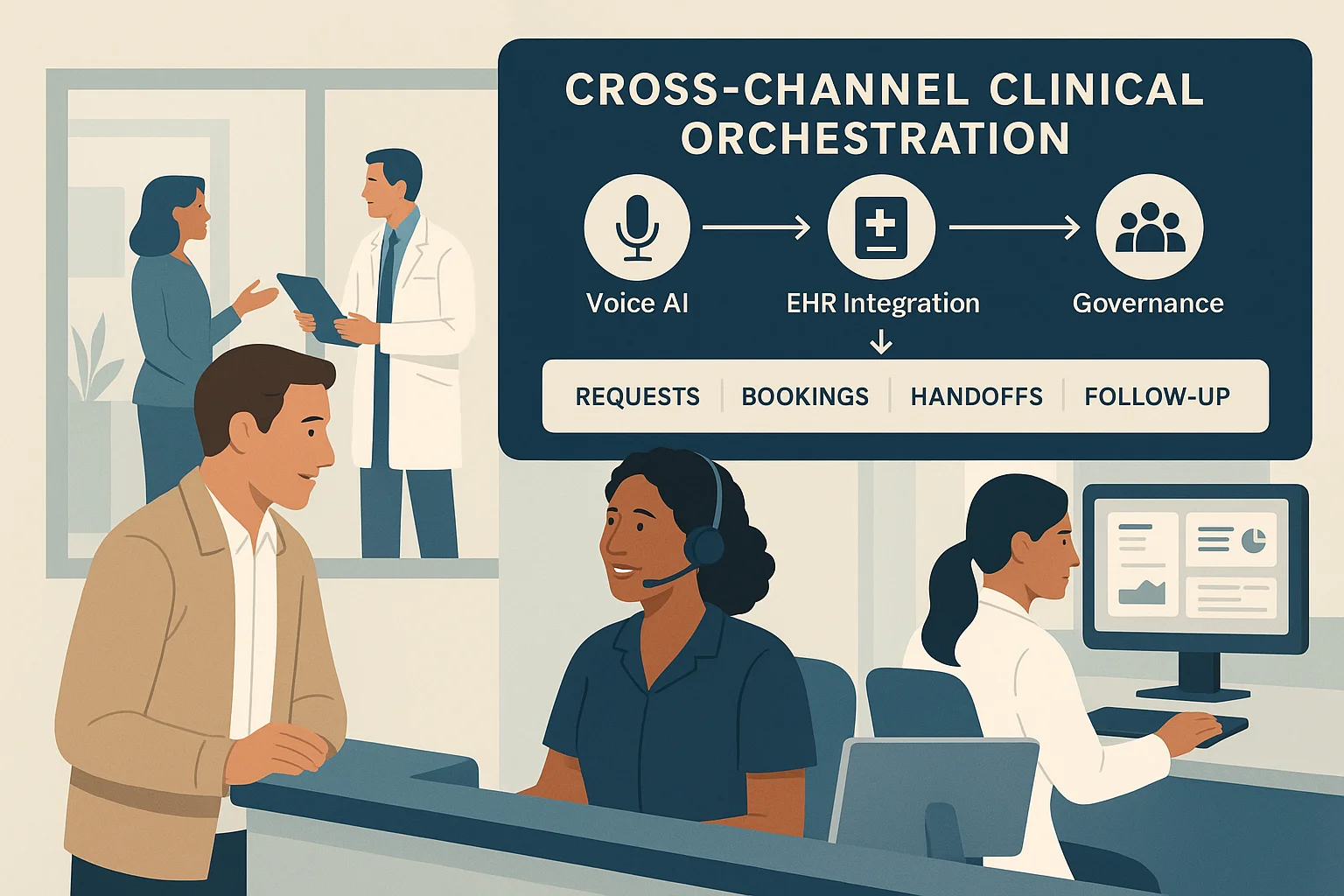
Cross-channel orchestration is the coordinated handling of a patient or caller across multiple interaction channels so the downstream clinical and administrative systems see a consistent representation of the interaction. For Voice AI projects this means stitching phone conversations into the same workflow state as web intake, secure messaging, and EHR events. It avoids duplicated work, prevents conflicting scheduling, and maintains an auditable patient-access trail.
- Single workflow state across channels (e.g., appointment requested, confirmed, pre-op checklist pending).
- Shared identifiers and transaction IDs that persist from call to EHR event.
- Orchestration layer that enforces policy (consent, identity validation, allowed actions).
Operational outcomes that matter to leaders
Decision-makers should track outcomes that reflect both access and safety: first-contact booking completion, after-hours call handling continuity, error-free scheduling transactions (write vs conflict rates), human escalations per 1,000 calls, and QA failure trends. These are the metrics that tie Voice AI investments to operational risk and capacity.
- Booking completion and downstream no-show trends.
- Rate of invalid or failed scheduling transactions requiring manual fix.
- Escalation volume and median time-to-human-response.
2. A practical Voice AI receptionist use case
A typical and decision‑useful deployment is a Voice AI receptionist that handles routine appointment booking and pre-visit intake, integrates with EHR/scheduling systems, and safely escalates when necessary.
Canonical workflow (architecture)
Use a clear, enforceable workflow pattern: Patient or caller → Voice AI ingestion (speech recognition + intent classification) → identity and consent validation → policy checks (scope of permissible actions) → approved scheduling or service API call → confirmation (SMS/email/voice) or human handoff. The orchestration layer contains adapters for EHR/PM, scheduling engines, and the contact-centre management system.
- Persist a transaction ID across channels and downstream systems for traceability.
- Apply policy execution to gate operations: e.g., only certain user types can request specific appointment types.
- Record the entire transaction metadata (not necessarily content) for QA and audit, subject to consent and retention policy.
Intake and scheduling boundaries
Define exactly which actions Voice AI may perform without human review. Typical allowed tasks: lookup available slots, book or cancel appointments, collect basic intake (demographics, insurance IDs), send reminders, and route to specialty queues. Disallow clinical tasks such as triage, diagnosis, medication changes or any activity that requires clinical judgment. When Voice AI detects clinical phrases or ambiguous intent it must escalate immediately to a trained clinician or triage nurse.
- Allowed: appointment booking, rescheduling, standard pre-op readiness checks that are checklist-style and non-diagnostic.
- Not allowed: triage for acute symptoms, medication changes, clinical advice — escalate these by design.
- Use intent-confidence thresholds to trigger human handoff for ambiguous responses.
3. Integration architecture and data flows
Integration choices determine reliability, auditability, and security. Use approved APIs, narrow adapters, and an orchestration layer that enforces policy rather than letting the voice engine directly write into clinical systems.
Orchestration layer and approved APIs
Implement an orchestration layer that mediates every action. The Voice AI component should call the orchestration API, which performs authentication, verifies authorization, transforms the payload, and invokes the target scheduling or EHR API. This pattern isolates the EHR from direct LLM or NLU outputs and centralizes logging, retries, and remediation.
- Use OAuth 2.0 or equivalent token-based service accounts for server-to-server calls.
- Implement idempotency keys for scheduling transactions to prevent duplicate bookings.
- Centralize retries and error-mapping to produce actionable operator tasks when transactions fail.
Identity, consent, and validation controls
Never permit write actions until the system completes identity verification and explicit consent for the requested action. Identity checks can be layered: primary identifiers (name + DOB), callback verification (call back to on-file number), knowledge-based checks for minor transactions, and optional third-party verification for higher-risk actions. Log which method was used and retain consent evidence.
- Require at least two data points to match EHR records before write actions.
- Treat voice biometrics as an optional layer—use only where legally and operationally approved.
- Record timestamped consent statements and associate them with the transaction ID.

4. Governance, risk and human oversight
Governance is not optional. Adopt a formal oversight model that assigns responsibilities, enforces boundaries, performs risk assessments, and maintains auditability in line with international guidance.
Ethics, oversight and documented boundaries
Establish a written governance charter that specifies permitted Voice AI actions, escalation triggers, human-in-the-loop roles, and data-retention rules. Regularly perform ethics and safety reviews for new workflows. Where clinical information is involved, require human review for any uncertain or clinically relevant content.
- Define ownership: clinical lead, data protection officer, IT integration owner, and contact-centre operations.
- Maintain a public-facing summary of how Voice AI is used for transparency to patients.
- Schedule periodic governance reviews when workflows change or new models are introduced.
Risk management and validation
Align your risk-management program to recognized frameworks and run regular control testing. Perform pre-deployment risk assessments, continuous monitoring, and post-incident root-cause analysis. Treat model drift, NLU misclassification, and API failures as controllable risks with documented mitigation and rollback plans.
- Use performance baselines and monitor drift metrics for intent classification and slot-filling accuracy.
- Validate every production release with a staged rollout and sampled human review.
- Document incident playbooks that include communication, recovery, and regulatory obligations.
Privacy, data residency and subprocessors
Document where voice transcripts, recordings, metadata, and logs are stored, who can access them, and how long they are retained. Distinguish between hosting region, backup geography, and subprocessors that may see personal data. Confirm obligations with qualified counsel because data residency and transfer rules vary by jurisdiction.
- Map every data flow: real-time audio, intermediate transcripts, orchestration logs, API payloads, and backups.
- Define retention and redaction policies aligned with local law and clinical records practice.
- Review subprocessors and third-party access patterns before enabling production traffic.

5. Procurement, vendor evaluation and implementation choices
RFPs and vendor selection should emphasize operational fit, integration depth, governance evidence, and demonstrable QA processes rather than glossy demos.
What to demand from vendors
Insist on RFP-ready artefacts: documented workflows mapped to your EHR/scheduling APIs, escalation playbooks, QA sampling plans, audit-log formats, and integration test suites. Require proof of the vendor’s ability to support identity validation, adapter versioning, and human escalation mechanisms.
- Workflow diagrams showing transaction flows and where human review occurs.
- Test cases and simulation results for common and edge-case scheduling conflicts.
- Evidence of secure operations: access controls, role separation, and change management.
Deployment and hosting decisions
Choose hosting and support modes that match your risk tolerance. Options include fully cloud-hosted managed services, customer-hosted virtual appliances, or hybrid deployments where sensitive artifacts remain in your environment. Consider remote-support access, subprocessors, and backup geography when evaluating vendors.
- If using managed services, require subprocessors disclosure and support-forensics SLA.
- Prefer encryption-at-rest and in-transit, and documented key-management responsibilities.
- Specify maintenance windows and change-notice timelines in contracts.
Proofs and staged acceptance
Use staged acceptance gates: sandbox integration, pilot on low-risk clinics, extended QA with operational KPIs, and contracted SLA activation. Acceptance criteria should include error rates for bookings, successful audit logging, and human-handoff latency.
- Pilot success criteria should be numeric and operationally meaningful (e.g., <X manual fixes per 1,000 bookings).
- Require the vendor to supply an exportable audit-log format for independent review.
- Enforce rollback criteria and a fast path to revert to human-only routing if safety thresholds are exceeded.
6. Operational controls, QA and measurable monitoring
Sustainable operations need repeatable QA, continuous monitoring, and human review workflows that scale with volume.
Quality assurance and sampling
Implement a QA program that combines automated checks with human sampling. Automate intent-confidence monitoring, failed transaction counts, and anomalies in scheduling conflicts. Human QA should sample both successful and failed transactions and provide feedback loops to model owners and integration teams.
- Define sampling rates based on risk: higher risk workflows get higher sampling frequency.
- Use labeled datasets from production sampling to retrain or tune NLU pipelines where allowed.
- Log outcomes of QA checks and attach remediation tickets to each failed sample.
Observability, alerting and audit trails
Expose operational telemetry: API latencies, intent-confidence distributions, idempotency conflicts, and human-handoff latency. Configure alerting for thresholds that indicate elevated risk (e.g., sudden drop in booking confirmations or surge in ambiguous intents). Ensure audit trails are immutable and readily exportable for compliance reviews.
- Maintain structured, time‑ordered audit logs that include transaction ID, actor, adapter version, and outcome.
- Stream key telemetry to a monitoring service with role-based access for compliance teams.
- Retain an evidence trail of model versions and training-data baselines associated with production releases.
Peak Demand differentiation: engineering and operational controls
Peak Demand builds Voice AI solutions with modular adapters, robust identity and field validation, safe escalation mechanisms, audit-ready logs, and human-review tooling. We deliver custom Voice AI that integrates scheduling and intake systems, supports optional field validation, and provides clear operator workflows for remediation and audits.
- Custom adapters for scheduling engines and EHR/PM systems with idempotent transaction handling.
- Human-review dashboards that attach audio, transcript, and transaction metadata to a single review ticket.
- Fail-safe routing: immediate reroute to a trained clinician for flagged clinical content.
Related Peak Demand resources
Industry and AI sources reviewed
- Ethics and governance of artificial intelligence for healthWorld Health Organization
- OECD AI PrinciplesOrganisation for Economic Co-operation and Development
- Artificial Intelligence Risk Management Framework (AI RMF 1.0)National Institute of Standards and Technology (NIST)
- Regulatory considerations on artificial intelligence for healthWorld Health Organization
Healthcare privacy, security, clinical-safety, records, and professional obligations vary by jurisdiction and workflow. This article is operational guidance, not legal advice; organizations should confirm applicable requirements with qualified professionals.
Frequently asked questions
Administrative workflows such as appointment booking, changes and cancellations, referral-status intake, approved follow-up, patient-access questions, after-hours overflow, and structured routing are common starting points. Clinical judgment, diagnosis, emergency triage, and prescribing decisions must remain with qualified professionals.
Use the minimum identifiers approved by the organization, validate them against the system of record, avoid exposing unnecessary information, and provide a human-assisted path when verification fails. The system should not infer identity from conversational context alone.
The agent should follow the organization's approved escalation and emergency-routing rules, avoid clinical advice, and transfer or direct the caller to the appropriate human or emergency channel. Those rules must be tested with realistic language and failure cases.
Request identity and privacy controls, scheduling or EHR integration behavior, audit logs, escalation rules, downtime handling, testing evidence, change control, monitoring, and clear separation between administrative automation and clinical decision-making.
Design a safe patient-service workflow before automating it
Peak Demand helps healthcare organizations connect Voice AI to scheduling, intake, patient communication, identity checks, escalation, and reporting with clear operational boundaries.
Schedule a discovery call


