Consolidating Voice AI Across Merging Health Systems: Integration & Governance
A practical playbook for consolidating Voice AI across merging health systems. Covers architecture, identity and privacy controls, EHR/scheduling integrations, QA and procurement guidance with clear safety boundaries.
1. A concise decision framework
Merging health systems commonly inherit multiple Voice AI pilots, third-party vendors, and inconsistent integrations. Consolidation can reduce duplication and improve patient experience—but only when approached as a controlled program with defined outcomes, responsibilities, and fallbacks.
When consolidation is appropriate
Prioritise consolidation when two or more of these conditions apply: duplicated or conflicting patient experience across sites, fractured integration points to EHR/scheduling systems, materially different escalation or safety policies, or measurable operational overhead from managing multiple vendors. Use a short assessment (4–8 weeks) to inventory callers’ top flows, technical endpoints, ownership, and legal constraints before committing.
- Inventory production flows: scheduling, cancellations, intake, simple prescription refills, after-hours routing.
- Map which EHR/PM/scheduling systems and APIs each Voice AI instance calls.
- Assess contract stages, subprocessor lists, and data residency constraints.
Business outcomes and risk boundaries
Define the outcomes you will measure (e.g., handled call rate, successful bookings, abandonment, safe escalation rate) and pair each outcome with an acceptable risk boundary (for example, maximum acceptable ambiguous-handback percentage). Explicitly document what the Voice AI must never do—diagnose, triage emergencies, prescribe, or replace clinician judgement—and design mandatory escalation triggers for any uncertainty.
- Target outcomes with quantitative thresholds and sampling rules for audit.
- Document forbidden actions in policy and technical guards.
- Determine failover: human-in-the-loop or voice message with call-back options.
2. Core operating model and reference architecture
A single canonical architecture reduces cognitive load for clinicians, operators, and vendors. Use a lightweight canonical flow that can be adapted to multiple sites while preserving safety and auditability.
Canonical call flow
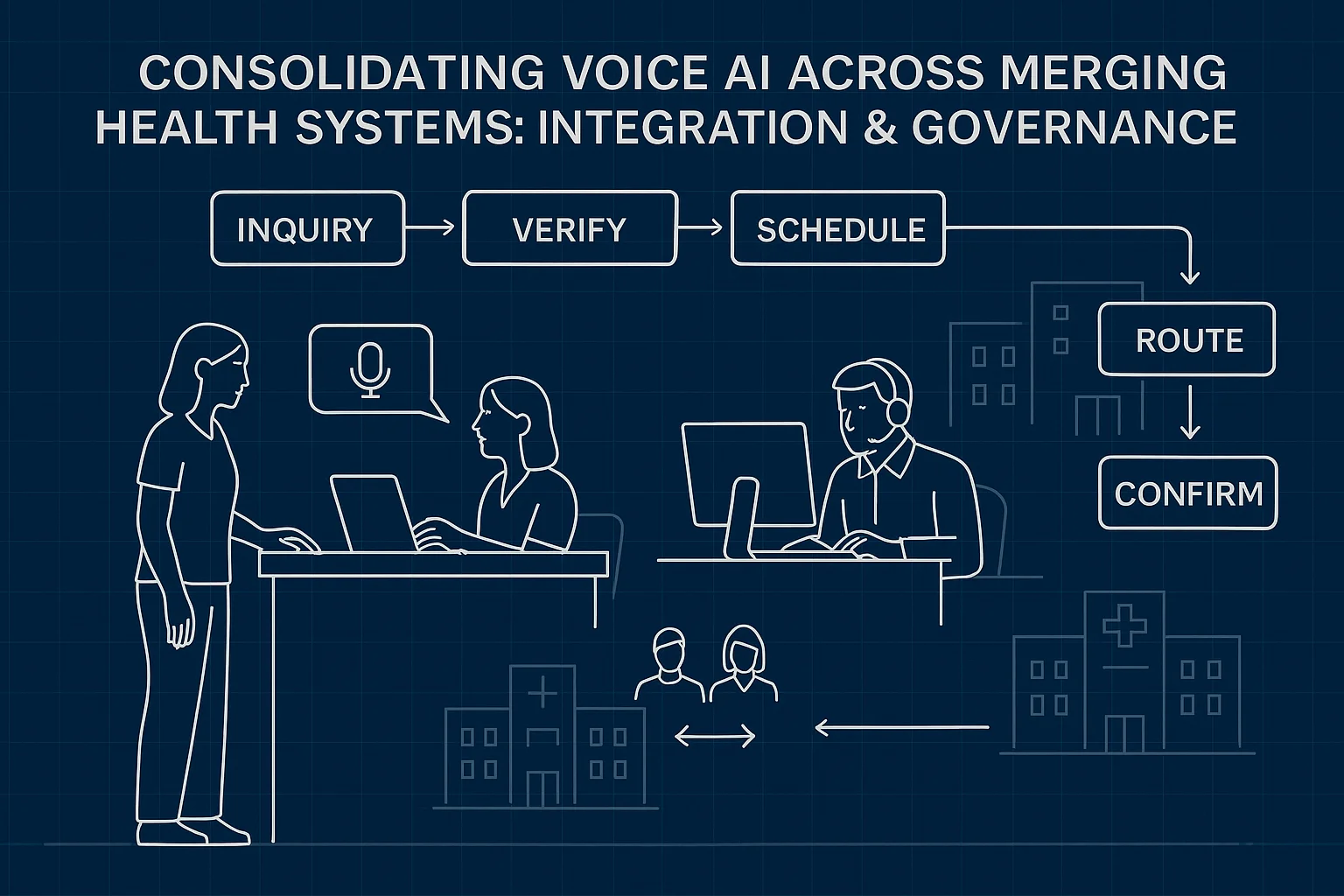
Standardise on a clear transaction path: Caller (patient or proxy) → Voice AI front end (NLP + dialog manager) → identity and validation controls → approved scheduling or service API → confirmation or human handoff. Keep an explicit orchestration layer (business logic/adapter tier) between Voice AI and clinical systems to enforce policy, perform transformations, and provide a single audit trail.
- Voice AI front end handles intent recognition and slot collection; never executes authoritative changes directly.
- Orchestration/adapter layer enforces identity checks, consent flags, and business rules before calling EHR/scheduling APIs.
- All write actions to clinical systems require a signed, auditable request from the orchestration layer.
Roles, responsibilities, and ownership
Split responsibilities explicitly in contracts and the SOW: vendor provides Voice AI models, NLU tuning, and connector primitives; health system owns orchestration rules, identity policies, and clinical/administrative boundaries; shared-responsibility for monitoring and QA must be detailed with SLAs and reporting cadences.
- Define who owns adapter updates when APIs change.
- Assign security responsibilities for keys, subprocessors, and remote-support access.
- Agree on escalation contacts, change windows, and release procedures.
3. Identity, validation and data governance
Identity and consent are the most operationally consequential controls in a patient-facing Voice AI. Design these controls to be deterministic, auditable and minimally disruptive to callers.
Identity verification workflows
Choose a composable identity approach: passive verification (matching caller-provided identifiers to EHR/PM records), active verification (PIN, SMS/IVR OTP), and knowledge-based validation where appropriate. Architect the orchestration layer so identity state is recorded and rechecked before any change to scheduling or patient records.
- Use the lowest-friction verification that meets risk tolerance for the transaction (e.g., booking vs. doing a protected-record update).
- Record verification method and timestamp in the audit trail.
- Design fallback flows: if verification fails, route to human agent or request alternative verification.
Consent, recording, and data residency
Explicitly capture consent for call recording and data use at call start for jurisdictions where required. Separate transient operational data (session logs, intermediate NLU artifacts) from persisted PHI and define retention, backup geography, subprocessors, and onward transfer rules in procurement documents. These choices affect tooling (encrypted storage, regional hosting, access controls) and remote-support arrangements.
- Document where live audio, transcripts, and structured metadata are stored and for how long.
- Specify subprocessors and mechanisms (e.g., Standard Contractual Clauses or equivalent) for cross-border transfers where relevant.
- Limit remote vendor access via secure bastions, recorded sessions, and role-based access logging.
4. Scheduling, EHR integrations and safe action gating
Most consolidation value comes from consistent scheduling and intake integrations. But care is required to ensure actions are idempotent, reconciled, and reversible where necessary.
Approved scheduling APIs and transaction validation
Use an adapter pattern: Voice AI proposes a transaction to the orchestration layer, which validates slots, checks scheduling rules (provider availability, double-book risk, appointment types) and performs the commit to the scheduling API. Confirmations to patients must include appointment identifiers and human-readable next steps.
- Implement idempotency keys and server-side validation to prevent duplicate bookings.
- Log both proposal and commit events; retain redo/undo metadata for reconciliation.
- Require final confirmation from scheduling system before informing the patient.
EHR/PM considerations and audit trails
Record every attempted write, the verification state, the adapter version, and the human agent (if any) involved. Maintain an immutable audit trail that maps call transcripts to the corresponding scheduling or record-change event to support dispute resolution, compliance reviews, and QA sampling.
- Store enough context to reproduce the transaction decision path during audits.
- Define sampling percentages for transcript-to-record reconciliation.
- Retain adapter and orchestration logs for change management and incident analysis.
5. Governance, QA and escalation controls
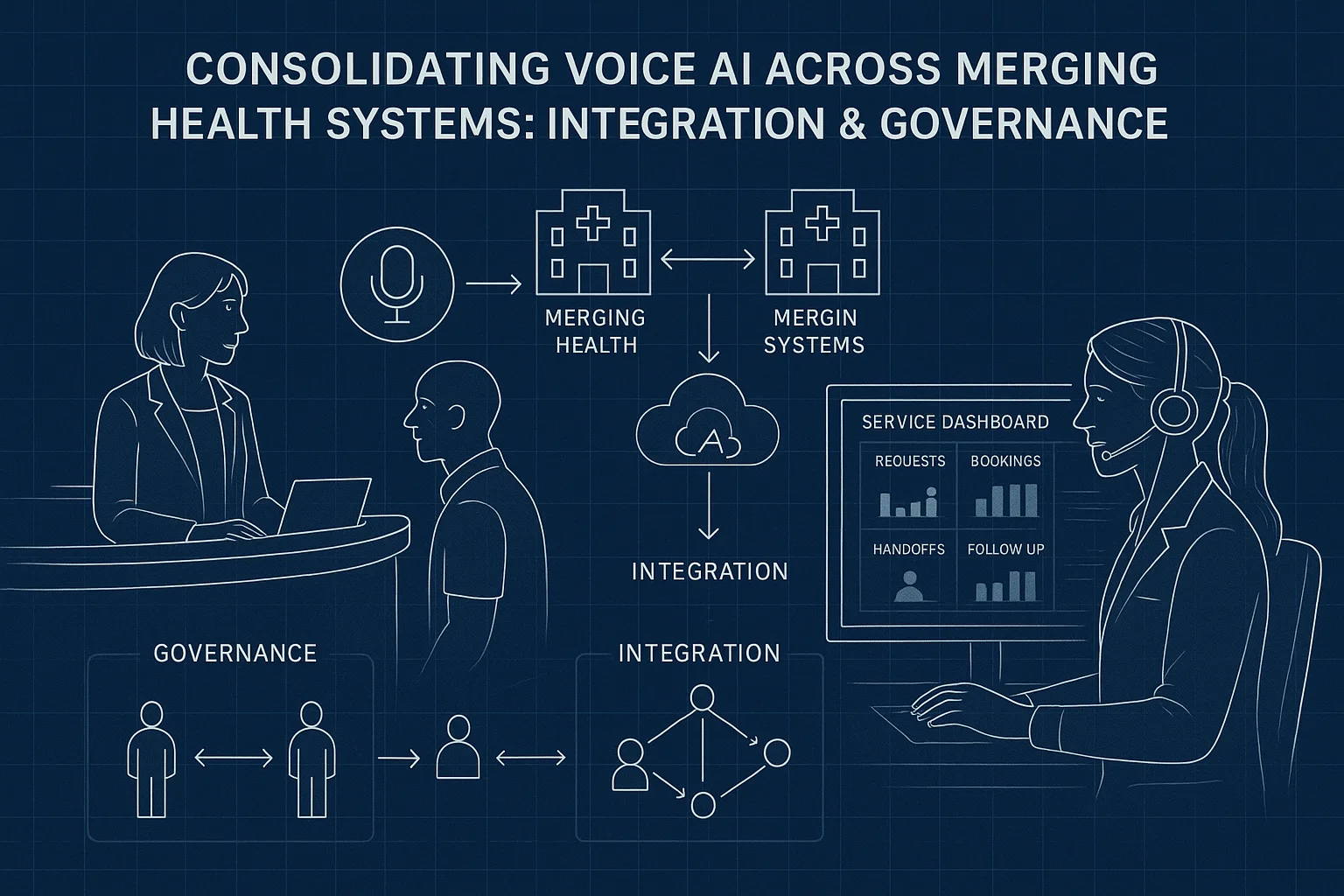
Operational consolidation must be underpinned by governance that combines ethical guidance, risk management frameworks, and continuous QA. Make governance practical: policies must tie directly to technical controls, runbooks, and measurable thresholds.
Policy, ethical boundaries and risk management
Adopt an AI governance charter that defines acceptable use, prohibited actions (e.g., clinical diagnosis), escalation triggers, and accountability. Align the charter with recognised guidance on AI in health and risk management—making sure policies are auditable and actionable.
- Define explicit clinical/administrative boundaries and scenario-based escalation rules.
- Map policy items to technical enforcements (e.g., block model outputs containing diagnostic language).
- Ensure human accountability and review for ambiguous or high-risk transactions.
QA, monitoring and human review
Implement layered QA: automated monitoring (intent drift, latency, error rates), routine sampling (transcript-to-outcome reconciliation), and a human-review queue for flagged transactions. Define Service Levels for handoff latency and error response, and embed post-release monitoring in the vendor contract.
- Set thresholds for automated alerts (intent mismatch rate, failed verifications).
- Use stratified sampling for QA: stratify by flow type, region, and time-of-day.
- Create a human-review workflow with access to full context: audio, transcript, intent, verification state, and adapter logs.
6. Procurement, implementation choices and measurable outcomes
Vendor selection and SOW drafting determine whether consolidation succeeds. Treat procurement as operational design—specify technical deliverables, runbooks, and measurable outcomes rather than only feature checklists.
Procurement evidence and SOW essentials
Require the vendor to show: connector implementations, test harnesses, change-management playbooks, subprocessor lists, and support for agreed hosting/backup regions. Specify adapter ownership, testing responsibilities, and an acceptance plan tied to operational KPIs.
- Demand demonstration in production-like conditions (not just canned demos).
- Include rollback and incident playbooks in the contract.
- Specify delivery milestones for adapters to each EHR/scheduling endpoint.
Measurable operating outcomes and KPIs
Track KPIs that map to your objectives and risk thresholds: handled-call rate, successful booking completion rate, false escalation rate, human-handoff latency, transcript-to-record reconciliation pass rate, and incident MTTR. Define the sampling size and cadence for QA and reporting.
- Pair each KPI with an SLA, alerting thresholds, and remediation steps.
- Report KPIs at an agreed cadence to a governance committee with technical and clinical representation.
- Use KPIs to gate production rollouts across business units.
7. Migration playbook and failure boundaries
A phased, reversible migration minimises disruption. Prepare concrete fallback actions for each common failure mode and test those fallbacks under load.
Phased migration
Start with a pilot on non-critical flows (e.g., routine follow-ups or allied health bookings) and a narrow caller subset. Progress to higher-volume and more complex flows only after meeting predefined KPI thresholds and QA pass rates. Use blue/green traffic switching and maintain the legacy path in parallel until acceptance.
- Define pilot duration, success criteria, and rollback triggers.
- Run end-to-end failure tests (API errors, identity mismatch, adapter failure).
- Gradually increase traffic volume and flow complexity.
Failure modes and safe handoff
Common failure modes include NLU confidence drop, EHR API failures, identity verification failures, and escalation bottlenecks. For each, implement deterministic handoffs: re-ask with limited retries, route to a human specialist, or schedule a safe-call-back with queued context. Never allow automatic clinical decisions without human review.
- Set maximum retry counts and timeouts for voice confirmations.
- Queue failed transactions with full context for human review; include replayable audio and adapter logs.
- Regularly test the handoff experience for agents and patients.
Related Peak Demand resources
Industry and AI sources reviewed
- Regulatory considerations on artificial intelligence for healthWorld Health Organization
- Artificial Intelligence Risk Management Framework (AI RMF 1.0)National Institute of Standards and Technology (NIST)
- Ethics and governance of artificial intelligence for healthWorld Health Organization
- OECD AI PrinciplesOrganisation for Economic Co-operation and Development
Healthcare privacy, security, clinical-safety, records, and professional obligations vary by jurisdiction and workflow. This article is operational guidance, not legal advice; organizations should confirm applicable requirements with qualified professionals.
Frequently asked questions
Administrative workflows such as appointment booking, changes and cancellations, referral-status intake, approved follow-up, patient-access questions, after-hours overflow, and structured routing are common starting points. Clinical judgment, diagnosis, emergency triage, and prescribing decisions must remain with qualified professionals.
Use the minimum identifiers approved by the organization, validate them against the system of record, avoid exposing unnecessary information, and provide a human-assisted path when verification fails. The system should not infer identity from conversational context alone.
The agent should follow the organization's approved escalation and emergency-routing rules, avoid clinical advice, and transfer or direct the caller to the appropriate human or emergency channel. Those rules must be tested with realistic language and failure cases.
Request identity and privacy controls, scheduling or EHR integration behavior, audit logs, escalation rules, downtime handling, testing evidence, change control, monitoring, and clear separation between administrative automation and clinical decision-making.
Design a safe patient-service workflow before automating it
Peak Demand helps healthcare organizations connect Voice AI to scheduling, intake, patient communication, identity checks, escalation, and reporting with clear operational boundaries.
Schedule a discovery call


